The Numbers Behind Nighttime Crash Rates
About 25% of driving happens at night, yet nighttime accounts for roughly half of all traffic fatalities in the United States. That disproportionate share is the clearest statistical signal that something meaningful changes after the sun goes down - and it isn't just traffic volume.
Factors like reduced police presence, higher rates of alcohol-impaired driving, and less predictable road conditions all converge after dark. Rural roads, which already carry higher fatality rates than urban ones (see city vs. rural driving safety risks), become even more hazardous at night due to minimal ambient lighting and unpredictable wildlife crossings.
Understanding these statistics isn't meant to discourage night driving - it's meant to help drivers go in with accurate expectations and appropriate habits.
~50%
of traffic fatalities occur at night
Despite accounting for only about 25% of total driving, nighttime conditions produce roughly half of all fatal crashes, according to NHTSA data.
3x
higher fatal crash rate per mile at night
NHTSA research indicates that when adjusted for miles driven, fatal crash risk is approximately three times greater after dark than during daylight hours.
160-250 ft
typical low-beam headlight range
Standard low-beam headlights illuminate a limited forward distance that may be insufficient for stopping at highway speeds, creating an inherent visibility gap.
88 ft/sec
distance traveled per second at 60 mph
At 60 mph, a vehicle covers roughly 88 feet every second - underscoring how quickly stopping distance can exceed headlight range on a dark road.
What Darkness Actually Does to Your Vision
The human eye uses two types of photoreceptors: cones (for detail and color in bright light) and rods (for low-light, peripheral, and motion detection). In darkness, the eye relies heavily on rods - and rods are far less effective at judging depth and distance. This is why nighttime driving feels less precise even when you think you can see fine.
Peripheral vision narrows at night, which is significant because the peripheral field is often where pedestrians, cyclists, and animals first appear. Glare from oncoming headlights adds another complication: it temporarily overwhelms rod cells, creating a brief window of genuine visual impairment that most drivers don't consciously register.
Older drivers are especially affected. The aging eye admits less light, recovers from glare more slowly, and may have conditions like cataracts that scatter light further. A 60-year-old driver may need significantly more light to achieve the same visual clarity as a younger driver - a difference that becomes critical in a nighttime emergency stop scenario.
The Headlight Gap: You're Often Driving Faster Than You Can See
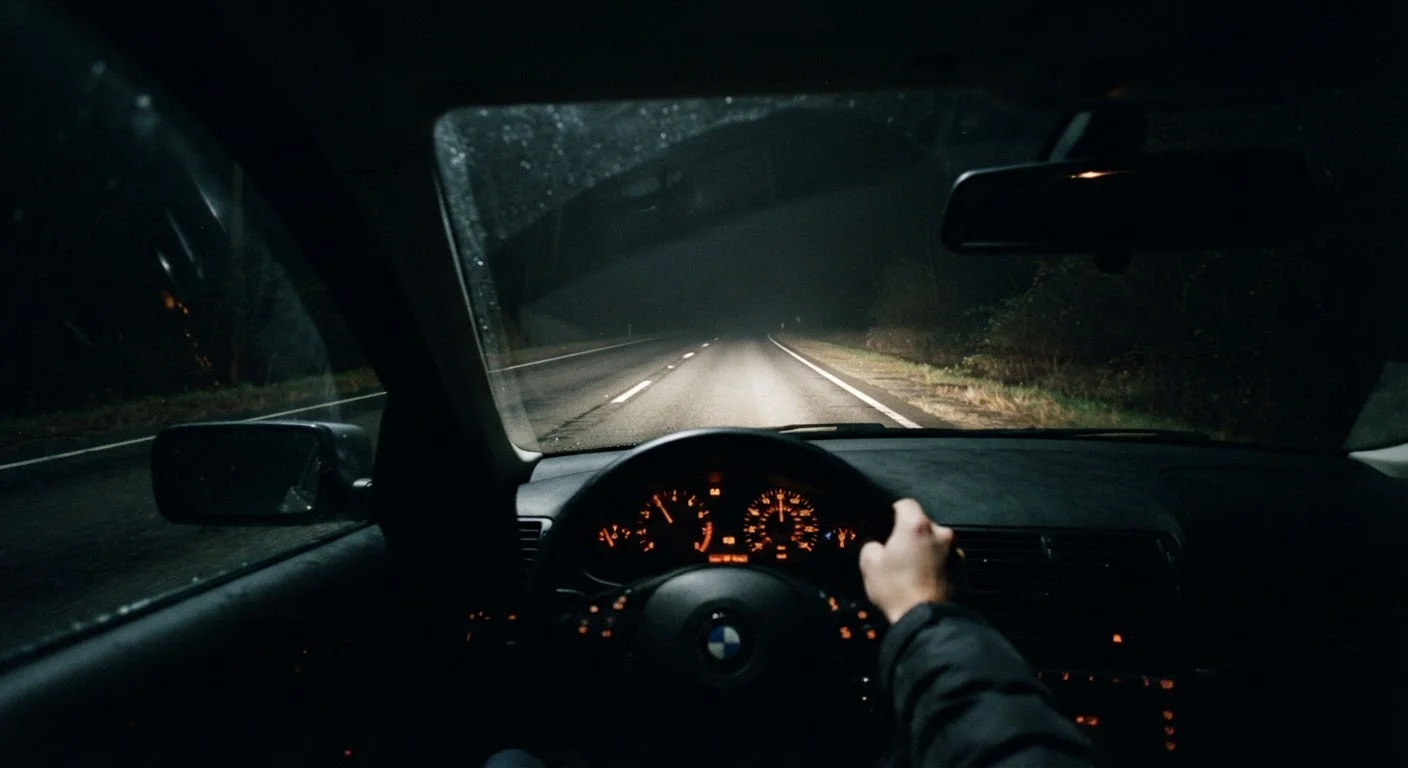
Standard low-beam headlights illuminate roughly 160 to 250 feet in front of your vehicle. At 60 mph, you're covering about 88 feet per second. Factor in reaction time - typically 1.5 seconds for an alert driver - and braking distance, and it becomes clear that at highway speeds, your stopping distance can easily exceed what your headlights reveal.
This is what safety researchers call "overdriving your headlights." It means that if a hazard appears at the edge of your illuminated range, you may not be able to stop in time, even if you react perfectly. Slowing down at night isn't timidity - it's physics.
Maintaining a longer following distance compounds the benefit. Following distance matters more than most drivers realize - and at night, that gap should be wider than your daytime habit. The same logic applies in adverse weather; see our guide to driving in rain, snow, and fog for how visibility stacks with other hazards.
Fatigue and Impairment: The Two Compounding Risks
Nighttime driving doesn't just change what you can see - it changes who is sharing the road with you and how alert you are. Both of these factors are significantly worse after dark.
The body's circadian rhythm naturally promotes drowsiness between midnight and 6 a.m. - and again in the early afternoon. Driving during the late-night window pushes against the brain's biological clock, increasing the likelihood of microsleeps (brief, involuntary lapses in awareness lasting under a second) even in drivers who don't feel tired. Drowsy driving shares many characteristics with alcohol impairment, including slowed reaction time and reduced hazard awareness.
Separately, drunk and drug-impaired driving is statistically concentrated in nighttime hours, particularly on weekends. NHTSA data consistently shows that the percentage of fatally injured drivers with blood alcohol content above the legal limit is far higher between midnight and 3 a.m. than at any other time of day. Staying alert and maintaining the kind of defensive driving mindset that anticipates unpredictable behavior from others is especially important during these hours.
Adjust Your Speed for Your Headlights
A practical rule for night driving: reduce your speed enough that you could stop comfortably within the distance your headlights illuminate. On unlit rural roads, that often means driving meaningfully slower than posted speed limits. Speed limits are set for ideal conditions - darkness changes those conditions.
Practical Habits That Reduce Your Nighttime Risk
No single adjustment eliminates nighttime risk, but several habits together make a meaningful difference. The most important ones are:
- Slow down. Even a modest speed reduction expands the time you have to respond to hazards within your headlight range.
- Increase following distance. Give yourself more buffer to the vehicle ahead, especially on highways where debris, stopped vehicles, or slowed traffic can appear with little warning.
- Keep your windshield and headlights clean. Dirt and film scatter light significantly, reducing both your forward visibility and your ability to recover from glare.
- Avoid looking at oncoming headlights. Shift your gaze slightly right toward the lane marking to reduce glare impact and maintain your road position reference.
- Take breaks on long night drives. Fatigue accumulates gradually and is often underestimated. Stopping every 90-120 minutes helps maintain alertness.
If you're driving with passengers at night, social dynamics can quietly affect your focus - conversation and distraction don't pause because conditions are more demanding.
This article provides general driving safety information for educational purposes only. Always follow local traffic laws and regulations.