Why These Two Environments Produce Different Crashes
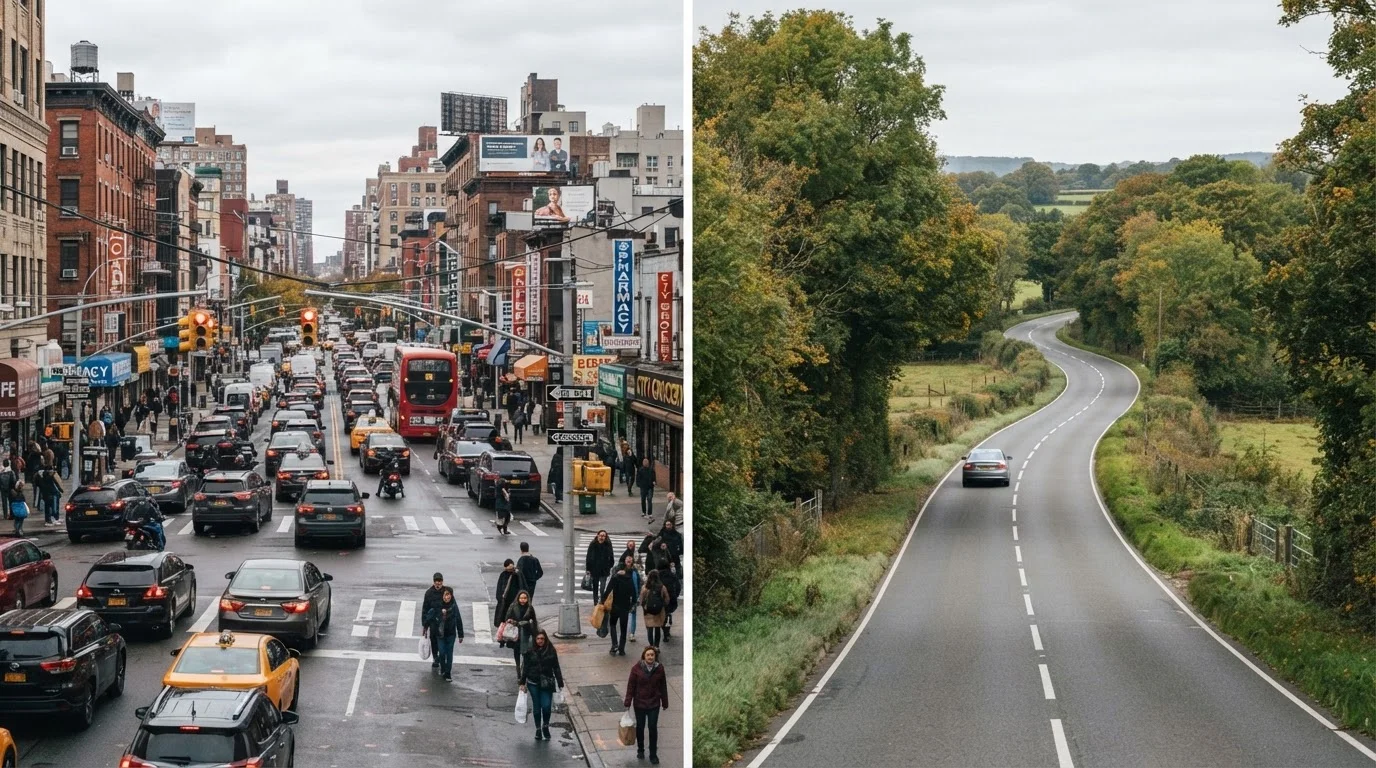
Most drivers think of road danger as a single concept - but where you drive shapes what kind of risk you actually face. City roads pack in more interactions per mile: pedestrians crossing mid-block, cyclists in blind spots, buses pulling into traffic, and drivers running late-yellow lights. Rural roads offer open space and fewer vehicles, but those conditions come with their own serious hazards.
According to the National Highway Traffic Safety Administration (NHTSA), rural roads consistently account for a disproportionately large share of traffic fatalities relative to their share of total miles driven. The reasons aren't hard to understand once you look at each environment on its own terms.
For drivers who move between environments regularly - or who are still building confidence behind the wheel - understanding the specific hazard profile of each setting is more useful than generic driving advice. See our guide for new drivers in their first year for a broader look at foundational habits that apply across both environments.
The Hazard Profile of City Driving
Urban driving is defined by density and decision frequency. You're rarely traveling faster than 35 mph, but you're making judgment calls every few seconds - yielding to a pedestrian stepping off the curb, watching for a cyclist merging right, reacting to a delivery truck double-parked in the lane ahead.
The most common crash types in cities reflect this environment:
- Intersection collisions - Left turns across oncoming traffic and red-light violations are leading causes of urban crashes.
- Rear-end collisions - Frequent stopping and starting, combined with distracted driving, produces a high volume of low-speed rear impacts.
- Pedestrian and cyclist crashes - Urban areas concentrate vulnerable road users. Crosswalk violations, failure to yield, and limited sight lines contribute to these incidents.
- Sideswipe crashes - Lane changes in stop-and-go traffic frequently catch cyclists or other vehicles in blind spots.
Lower speeds reduce the chance that any single crash proves fatal, but the sheer volume of interactions raises overall collision frequency. Distraction is a major amplifier in these settings. For a closer look at how intersection behavior goes wrong, the road rules Americans most commonly misunderstand covers specific situations where assumptions replace actual law.
| Criterion | City Driving | Rural Driving |
|---|---|---|
| Typical speed range | 25-45 mph | 55-70 mph |
| Crash frequency | Higher - more interactions | Lower - fewer vehicles |
| Crash fatality rate | Lower - slower speeds | Higher - speed and isolation |
| Top hazards | Pedestrians, cyclists, intersections | Speed, wildlife, fatigue, road design |
| Emergency response time | Typically faster | Typically longer |
| Road infrastructure | Signals, crosswalks, lighting | Often no guardrails or streetlights |
| Main driver risk factor | Distraction and overconfidence | Speed and drowsiness |
The Hazard Profile of Rural Driving
Rural roads look safer on the surface - light traffic, open sightlines, no pedestrians darting between parked cars. But the fatality data tells a different story. Several structural factors combine to make crashes on rural roads significantly more deadly when they do occur.
Speed is the most important factor. Most rural roads have posted limits of 55 mph or higher, and many drivers treat light traffic as an invitation to go faster. At higher speeds, stopping distances increase dramatically, and crash forces are exponentially greater.
Road design also plays a role. Many rural roads lack centerline rumble strips, guardrails, adequate shoulders, and lighting. When a driver drifts or overcorrects, there's less infrastructure to contain the outcome.
Emergency response time is longer in rural areas. A crash that might be survivable in a city - where EMS can arrive in minutes - becomes more serious when response times stretch to 20 minutes or more.
Other rural-specific hazards include:
- Drowsy driving - Long, monotonous stretches of road are strongly associated with fatigue-related crashes. See our guide on the hidden risks of drowsy driving for warning signs and what actually helps.
- Wildlife crossings - Deer, elk, and other animals cross unpredictably, especially at dawn and dusk.
- Unmarked driveways and intersections - Rural roads frequently have pull-offs and cross streets with little or no signage.
- Reduced lighting - Many rural roads have no streetlights at all. For more on that hazard, night driving research explains why darkness raises risk beyond just visibility.
Habits That Help in Each Environment
Adjusting your behavior to match the road you're on is the core of practical driving safety. Here's what that looks like in practice:
In city environments:
- Increase following distance even at low speeds - rear-end collisions happen faster than most drivers expect.
- Treat yellow lights as stop signals when safe to do so, rather than acceleration cues.
- Scan crosswalks before turning, not just the direction of oncoming traffic.
- Be especially alert near transit stops, schools, and loading zones where pedestrian activity is unpredictable.
On rural roads:
- Respect posted speed limits even when the road feels open - they're often set based on sight distance and curve geometry, not just traffic volume.
- Take breaks every two hours on long drives to counter fatigue. Drowsy driving impairs judgment in ways that caffeine alone won't fix.
- Use high beams where legal and appropriate, and reduce speed at dawn and dusk when wildlife activity peaks.
- Slow down before crests and blind curves - assume something may be in the road on the other side.
A defensive mindset applies in both environments but looks different in each. Understanding the defensive driving spectrum can help you identify specific habits worth building regardless of where you drive most.