Why Road Rule Myths Stick Around
Most American drivers passed their written licensing test years - sometimes decades - ago. Since then, day-to-day habits, informal advice from other drivers, and regional differences in enforcement have quietly replaced what the actual statutes say. The result is a mix of half-remembered rules and confidently repeated myths that contribute to preventable conflicts and crashes.
This isn't about catching anyone out. Road rules are genuinely confusing in places, and several vary meaningfully by state. The goal here is simply to replace assumptions with accuracy so you can drive with more confidence and fewer surprises. For a complementary look at roundabout rules that trip up even experienced drivers, see how roundabouts actually work.
Myth
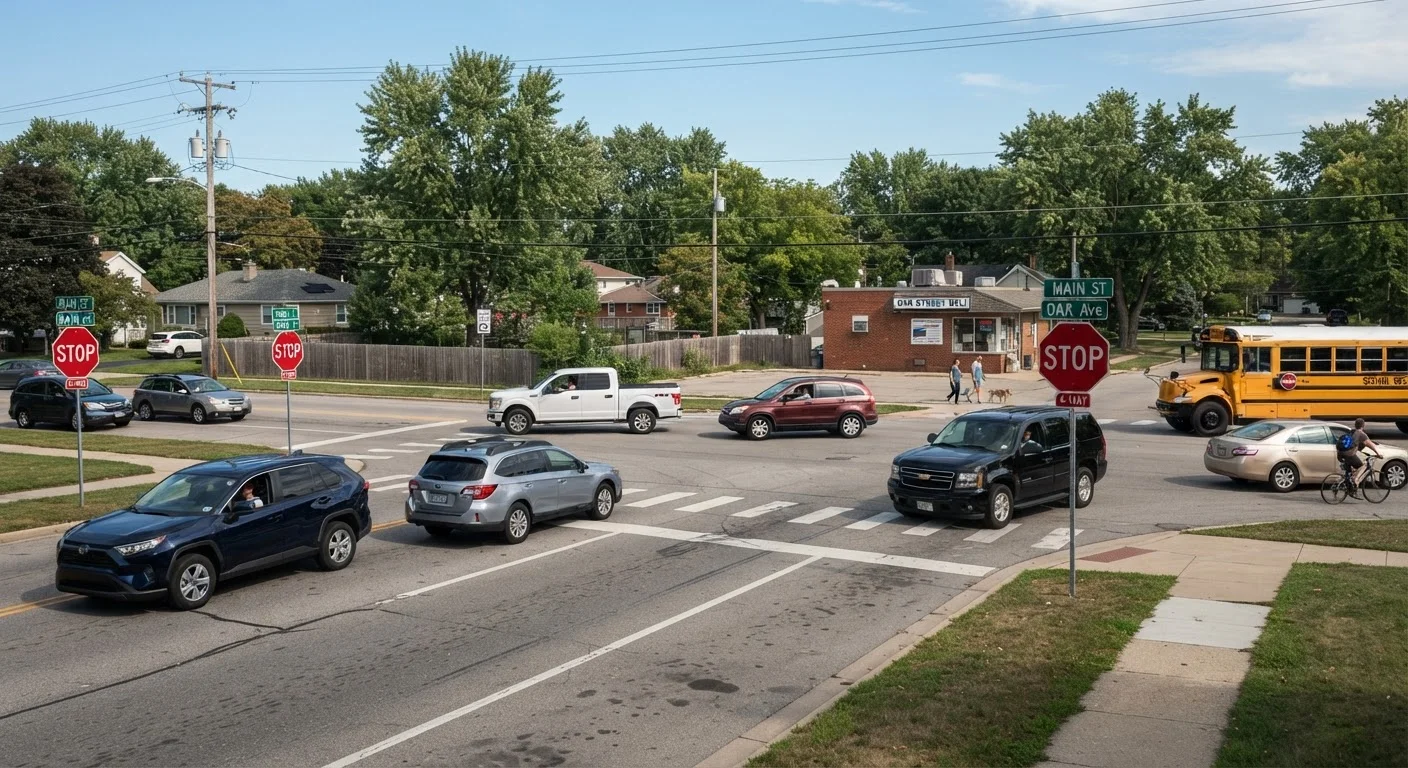
At a four-way stop, you always yield to the car on your right.
Fact
The vehicle that arrives first has the right of way. The 'yield right' rule is a tiebreaker for simultaneous arrivals only.
The right-of-way-to-the-right principle applies specifically when two or more vehicles reach a four-way stop at the same moment. In that narrow scenario, you yield to the driver on your right. But if one car arrived before you - even by a second or two - that driver proceeds first regardless of their position relative to yours. Treating the right-side rule as always-applicable is one of the most common sources of hesitation and miscommunication at stops.
Myth
You only have to yield to pedestrians if they're already in the crosswalk.
Fact
In most states, the law requires you to stop for pedestrians who have stepped off the curb and are waiting to cross, not only those already in your path.
State pedestrian right-of-way laws vary somewhat, but many go further than requiring a stop once someone is in front of your vehicle. A pedestrian who has entered the roadway - including at an unmarked crosswalk at any intersection - typically has legal right of way. Waiting until they're directly in your lane before stopping is both legally risky and dangerous. Check your specific state statute for the exact threshold, since wording differs.
Myth
The left lane is the 'fast lane' and you can stay there as long as you're above the speed limit.
Fact
Most states require slower traffic to keep right, and several have laws specifically prohibiting left-lane camping regardless of your speed.
Driving above the posted speed limit does not grant you the right to occupy the left lane continuously. Statutes in a growing number of states explicitly prohibit using the left lane for anything other than passing or turning left. Blocking the passing lane - even at highway speeds - can result in a citation in those states. The practical effect of left-lane blocking is also a well-documented contributor to rear-end collisions and road rage incidents. See also how following distance works at highway speeds for related safety context.
Myth
Turning right on a red light is always legal in the U.S.
Fact
Right-on-red is permitted in most situations after a full stop, but it can be prohibited by posted signs, local ordinance, or specific intersection design.
Right turns on red became broadly legal across the U.S. after the 1970s energy crisis, but exceptions are common and enforceable. A posted 'No Turn on Red' sign overrides the general rule. Some jurisdictions - including certain urban districts - prohibit it categorically at many intersections. And in all cases, a complete stop is required before proceeding, with a clear yield to crossing pedestrians and oncoming traffic. Rolling through on red is a separate violation even where the turn itself is permitted.
Myth
When an emergency vehicle approaches, you just need to slow down and move over a little.
Fact
The law in every U.S. state requires you to pull to the right edge of the road and stop completely until the emergency vehicle has passed.
Simply slowing or nudging right doesn't satisfy the legal requirement. You are required to pull as far right as safely possible and come to a complete stop. On highways, most states also have 'Move Over' laws requiring drivers to change lanes away from stopped emergency vehicles on the shoulder - not just slow down. Violations of these laws carry significant fines and, in cases involving crashes with first responders, criminal charges in some jurisdictions.
How Knowing the Rules Changes Your Driving
Understanding actual law - not just traffic custom - has practical consequences. Drivers who misread right-of-way at intersections are a leading contributor to angle crashes, which account for a significant share of injury collisions in the U.S. Pedestrian right-of-way errors are similarly linked to some of the most serious urban incidents.
Beyond safety, incorrect assumptions can affect you legally. If a crash occurs and you were operating under a misconception rather than following statute, fault determinations and insurance claims can go against you even when you believed you were in the right. For the broader picture on how city and rural driving hazards differ, each environment brings its own rules-in-practice challenges worth understanding.
Reviewing your state's current driver's manual periodically is a straightforward way to stay current. Rules do occasionally change, and what applied when you first got your license may have been updated since. Many state DMV websites offer digital versions at no cost.
Don't Rely on What Other Drivers Do
Local driving customs often diverge from written law - especially in areas where enforcement is light. Following the flow of traffic may feel safer socially, but it won't protect you legally if a crash occurs. When other drivers behave in ways that seem incorrect, yield cautiously rather than matching their behavior. Your obligation is to the law, not to informal norms.