Why Roundabouts Confuse American Drivers
The United States built its road network around traffic signals and four-way stops. Roundabouts, while common in Europe and Australia for decades, were relatively rare in the U.S. until transportation planners began installing them more widely starting in the 1990s. That late adoption means many American drivers never learned the rules in driver's ed - and encounter roundabouts for the first time as adults, often mid-commute.
The confusion tends to cluster around two problems: not knowing who yields to whom, and not knowing which lane to choose in a multi-lane roundabout. Both issues are solvable with a clear explanation of how the system is designed to work. As noted in our breakdown of commonly misunderstood road rules, roundabout right-of-way is one of the top areas where drivers operate on assumptions rather than actual knowledge.
The good news: roundabouts are genuinely safer than traditional signalized intersections for most crash types. Research from the Insurance Institute for Highway Safety has found that roundabouts reduce injury crashes substantially compared to stop-sign and signal-controlled intersections, primarily because they eliminate high-speed right-angle and left-turn collisions. Understanding them isn't just a test question - it has real safety implications.
Pedestrians Always Have the Right of Way
Crosswalks at roundabout entries and exits are active zones. Before entering or exiting the circle, check for pedestrians and cyclists - they have the right of way in marked crossings. Never speed up to beat a pedestrian through a crosswalk. This is both a legal requirement and a critical safety habit.
What You'll Need Before You Approach
No special equipment is required to navigate a roundabout, but two things on your car need to be working and in your active awareness before you enter.
Turn signals / blinkers
Used to indicate which exit you intend to take, helping other drivers and pedestrians anticipate your path.
Side and rearview mirrors
Essential for checking circulating traffic before entering and for monitoring adjacent lanes in multi-lane roundabouts.
Beyond equipment, the mental prerequisite is knowing your destination exit before you arrive. If you're unfamiliar with the area, check your route in advance. Trying to read a map app at the yield line causes exactly the kind of hesitation that creates rear-end collisions. If you miss your exit, don't stop - continue around the circle and take your exit on the next pass.
What you will need
How to Navigate a Roundabout, Step by Step
Follow these steps in order each time you approach a roundabout. With repetition, the sequence becomes automatic - much like merging onto a highway. If merging under pressure is something you find stressful, see our guide on building confident merging habits - many of the same scanning and gap-judgment skills apply.
Slow down as you approach
Reduce your speed well before the roundabout's yield line. Posted advisory speeds inside roundabouts typically range from 15 to 25 mph, and approach speeds should drop accordingly. This gives you enough time to read the signs, check for circulating traffic, and choose the correct lane.
Choose your lane before you enter
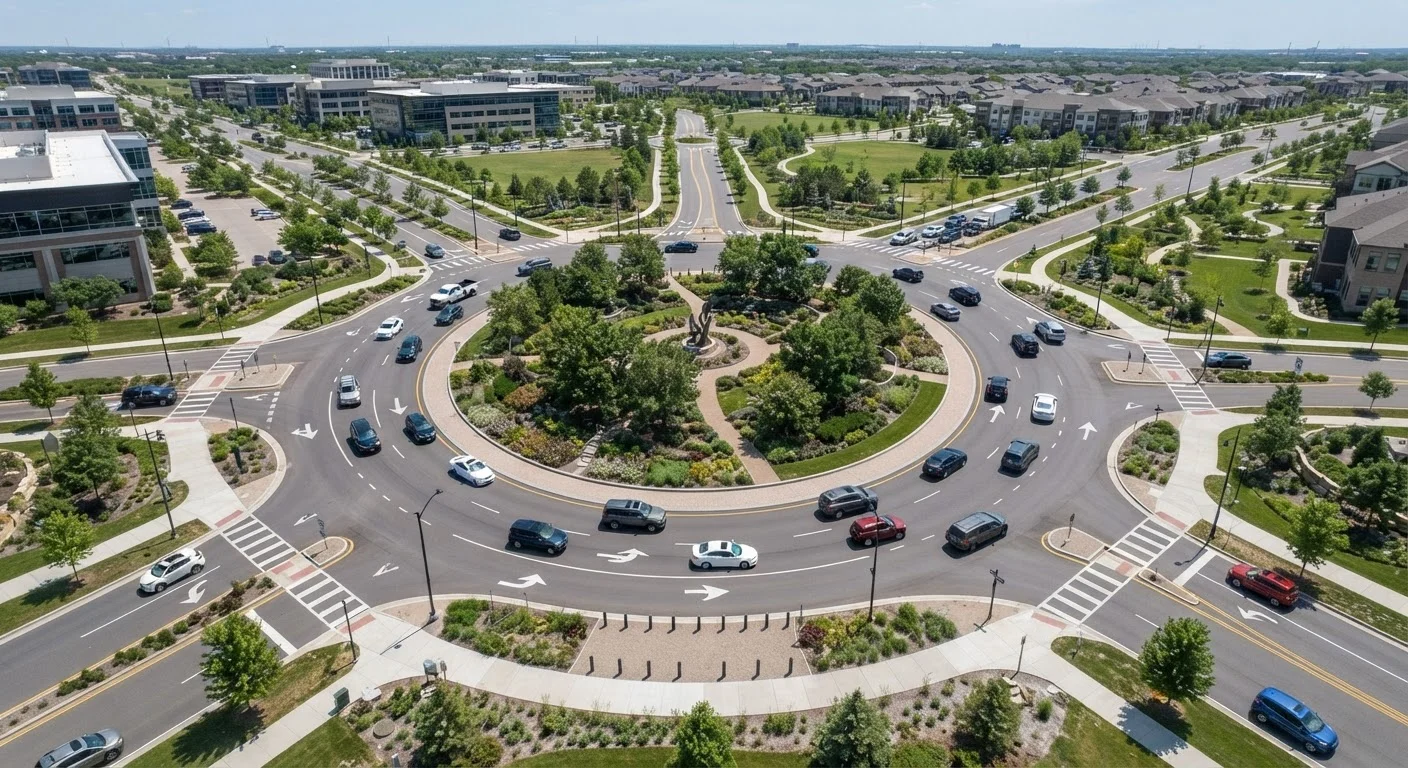
In a single-lane roundabout, lane choice isn't an issue. In a multi-lane roundabout, the general rule is: use the right lane for right turns and straight-through exits, and the left lane for left turns or U-turns. Check pavement markings and signs - they vary by location and are your primary guide.
Yield to traffic already in the circle
At the yield line, look left. Any vehicle already traveling inside the roundabout has the right of way. Wait for a safe gap before entering. Do not cut off circulating traffic, and do not expect drivers inside to stop for you - they are not required to.
Enter and stay in your lane
Once a safe gap appears, enter smoothly and maintain your lane position as you travel counterclockwise around the central island. Keep your speed steady and low. Avoid braking abruptly inside the circle unless necessary - other drivers are following closely behind.
Signal before your exit
As you pass the exit just before your intended turn-off, activate your right turn signal. This alerts drivers waiting to enter and any pedestrians near the crosswalk that you are about to exit. Early signaling gives everyone around you time to react.
Exit and yield to crosswalk users
As you leave the roundabout, check the crosswalk at the exit. Pedestrians and cyclists crossing the exit road have the right of way. Slow down, yield if needed, and then continue on your way. Turn off your signal once you've cleared the crosswalk area.
Treat It Like a Yield Sign, Not a Stop Sign
Many drivers instinctively stop completely before entering a roundabout, which disrupts traffic flow and can cause rear-end collisions behind you. Slow down and scan for circulating traffic, but if the roundabout is clear, you can enter without stopping. The goal is a smooth, rolling merge - not a full stop.
Common Mistakes and How to Avoid Them
Even drivers who understand the rules in theory tend to make a few predictable errors when they're actually in a roundabout. Knowing them in advance helps you catch yourself before they become a problem.
- Stopping inside the roundabout: Only stop inside a roundabout if there's an imminent collision risk. Otherwise, keep moving. Stopping in the circle is unexpected and dangerous for drivers behind you.
- Yielding to entering traffic: You do not need to yield to vehicles waiting to enter the roundabout. Once you're inside the circle, you have the right of way. Slowing for entering cars creates confusion and congestion.
- Ignoring lane markings: Multi-lane roundabouts have pavement arrows that are legally binding guides. Follow them. Drifting between lanes is a leading cause of sideswipe collisions inside the circle.
- Forgetting to signal: Skipping your exit signal is a courtesy failure that can also cause conflicts with pedestrians at crosswalks who have no way of knowing you're about to exit.
Roundabouts appear in both urban and rural settings, each with their own distinct driving demands. For a broader look at how road environments affect risk, see our comparison of city and rural driving hazards. New drivers in particular benefit from understanding roundabout rules early - for a fuller picture of first-year driving challenges, our new driver guide covers the situations that matter most.