Why the Three-Second Rule Exists - and Where It Falls Short
The three-second rule is taught in driver's education for a good reason: it's easy to remember and it works reasonably well in light traffic at moderate speeds. But many drivers treat it as a universal solution, when it's really a starting point.
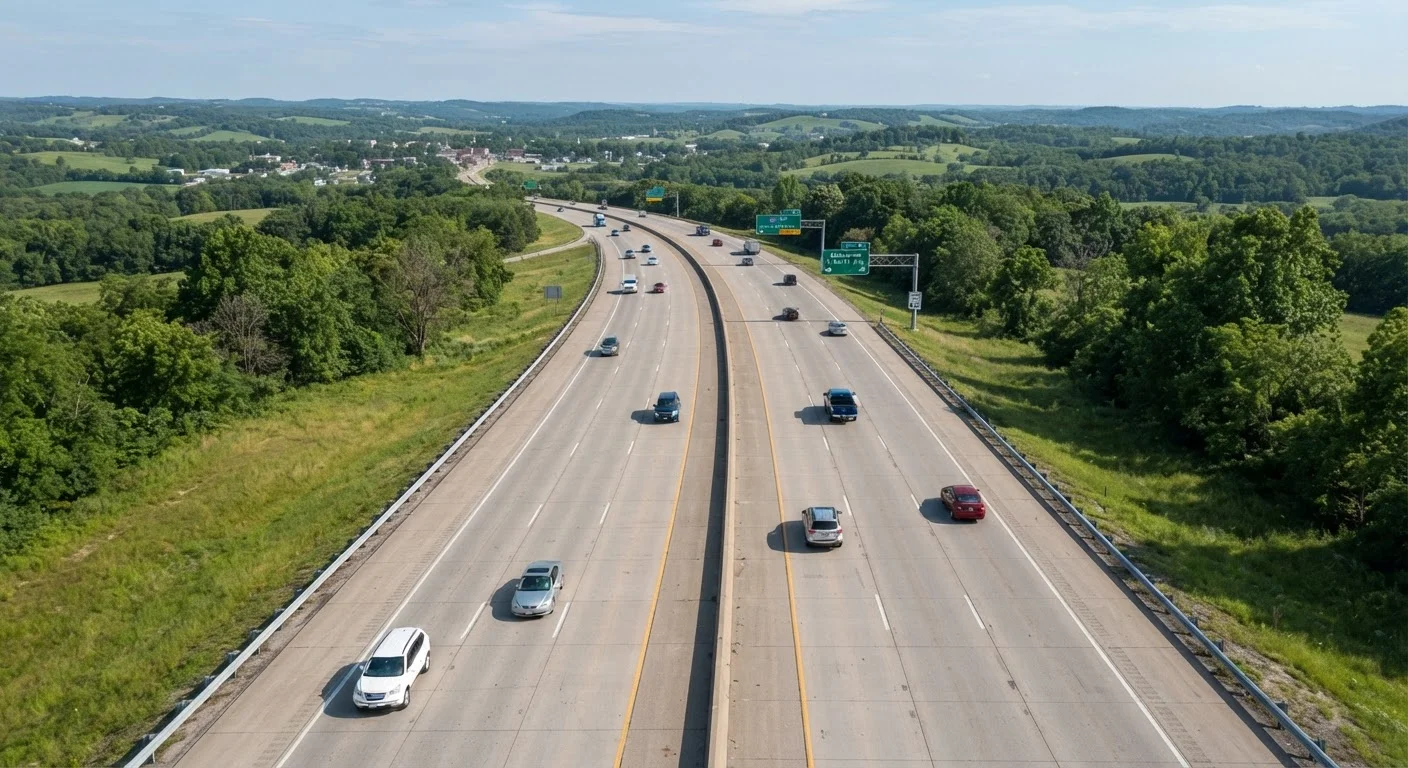
Here's the practical problem. At 65 mph, you're covering roughly 95 feet every second. A three-second gap puts about 285 feet between you and the car ahead. That sounds like a lot - until you account for reaction time. The average driver takes 1.5 seconds to perceive a hazard and move their foot to the brake. That's 142 feet already gone before braking even starts. At that point, you have fewer than two seconds of actual braking distance left - on a dry road with good tires.
If you're tired, distracted for even a moment, or driving a heavier vehicle like a truck or SUV, that margin shrinks further. On highways, four to five seconds is a more realistic target, and that's still under ideal conditions.
~95 ft
Distance traveled per second at 65 mph
Basic physics calculation: 65 miles per hour equals approximately 95.3 feet per second, meaning reaction time alone consumes substantial road space.
1.5 sec
Average driver reaction time to a hazard
The Federal Highway Administration and traffic safety researchers commonly cite 1.5 seconds as a baseline perception-reaction time for alert drivers.
~4x
Braking distance increase when speed doubles
Because kinetic energy grows with the square of velocity, doubling speed roughly quadruples the distance required to stop, not merely doubles it.
The Physics Behind Stopping Distance
Stopping distance isn't linear - it compounds. When you double your speed, your braking distance doesn't double; it roughly quadruples. That's because kinetic energy (the force your brakes must overcome) increases with the square of your velocity.
At 30 mph on dry pavement, a typical passenger car might stop in around 75 feet total. At 60 mph, that figure jumps to roughly 240 feet or more - not 150 feet as a simple doubling would suggest. At 70 mph, you're looking at over 300 feet in many vehicles.
This also means that the difference between 60 mph and 70 mph is not just 10 mph of extra speed - it's a meaningful increase in the distance you need to survive a sudden stop. The speed limit isn't just a legal threshold; it's calibrated partly around these physics realities. For a deeper look at what posted speed signs actually communicate, see our explainer on posted vs. advisory speed limits.
When Conditions Demand More Space
The three-second rule assumes dry pavement, daylight, alert drivers, and good tires. Change any one of those variables and your required following distance increases.
- Rain: Water reduces tire grip, which extends braking distance. A common guideline is to at least double your following distance in wet conditions.
- Night driving: Your reaction time can increase because you're processing less visual information. Nighttime driving carries higher risk for reasons beyond just visibility.
- Worn tires: Tread depth directly affects braking. Tires near the wear limit can add dozens of feet to your stopping distance on wet roads.
- Heavy vehicles: Trucks, SUVs, and vans carry more momentum and take longer to stop than compact cars - their drivers need more buffer, not less.
- Distraction or fatigue: Both extend your reaction time, consuming more of whatever gap you've left yourself.
For a full picture of how conditions interact with safe driving, our guide to low-visibility driving covers the major scenarios in practical detail.
The Hidden Cost of Tailgating
Tailgating doesn't just increase crash risk - it removes your ability to make choices. When you're one second behind the car ahead, you have almost no options if they brake hard. You can't steer around them at highway speeds without a longer sight line. You have no time to even complete the full motion of pressing the brake pedal.
There's also an often-overlooked financial dimension. Rear-end collisions are among the most common crash types in the U.S., and the following driver is almost always considered at fault. That means insurance claims, potential rate increases, and possible legal liability - all consequences that a larger following gap would have prevented.
Counterintuitively, maintaining more distance also makes driving less stressful. You're not constantly reacting to the car ahead. Your braking and acceleration become smoother, which reduces fuel consumption and wear on your brake pads over time.
Following distance is one of those habits that separates experienced, low-incident drivers from reactive ones. Understanding it is also part of a broader picture of road behavior - many commonly misunderstood rules contribute to the same category of avoidable crashes.