Why Tires Deserve More Attention
Tires are the only part of your car that actually touches the road. Everything your vehicle does - accelerating, braking, turning - depends entirely on four patches of rubber roughly the size of your hand. Despite that, tires are one of the most neglected parts of routine car care.
The consequences of ignoring tires go beyond a flat. Underinflated tires reduce fuel economy, wear out faster, and can overheat at highway speeds. Worn tread increases braking distance, especially in rain. A blowout at speed can cause a driver to lose control. Most of these risks are preventable with a few minutes of attention each month.
If you're working on building a broader maintenance routine, our car maintenance schedule guide walks through what each service milestone actually means.
Tire Pressure: The Basics
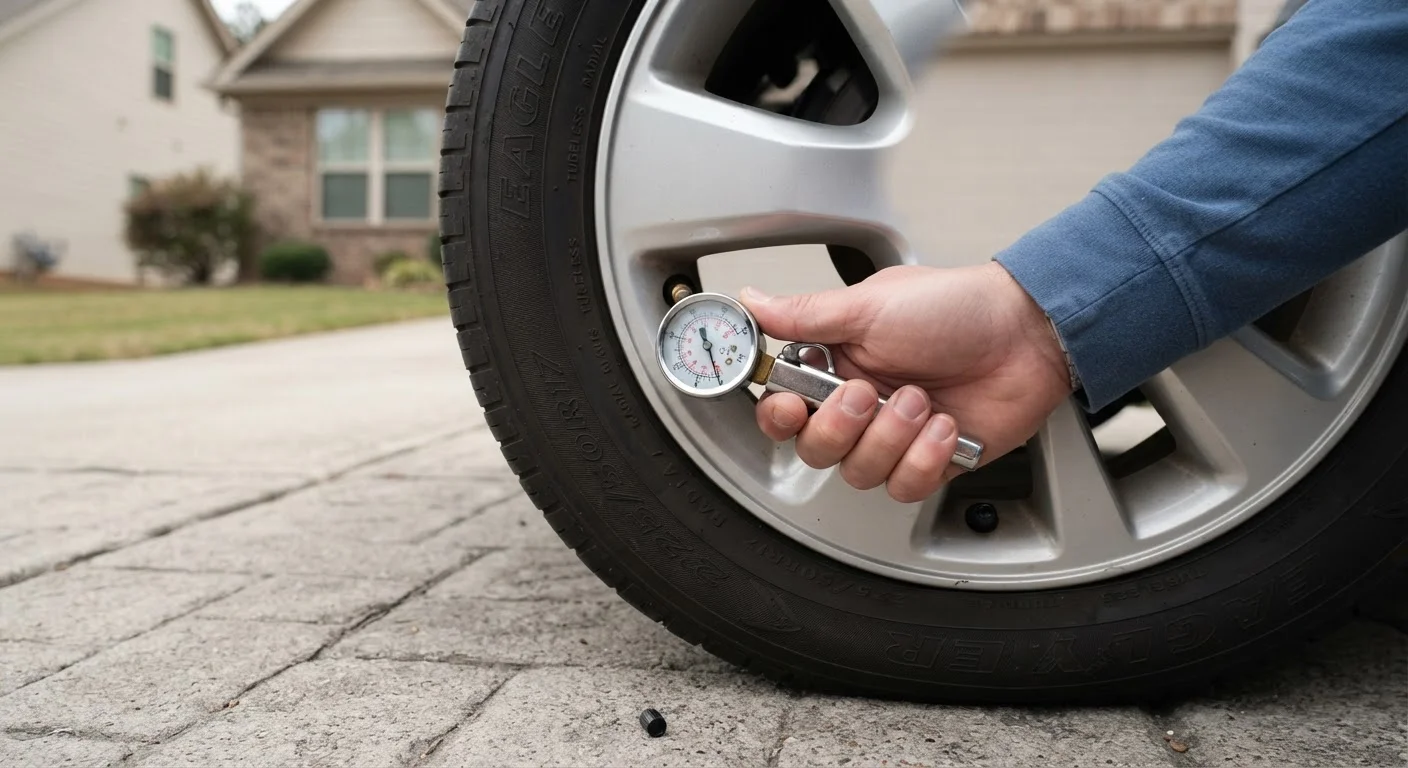
Tire pressure is measured in PSI - pounds per square inch. The correct pressure for your vehicle is listed on a sticker inside the driver's door jamb (or sometimes inside the fuel door or glove box). Do not use the number printed on the tire sidewall - that's the maximum pressure the tire can hold, not the recommended inflation for your car.
Most passenger cars call for somewhere between 30 and 35 PSI, but the right number depends on your specific vehicle. Check pressure when tires are cold - meaning the car hasn't been driven for at least three hours - because driving heats the air inside and temporarily raises the reading.
Pressure drops naturally over time. Tires can lose about 1 PSI per month just from normal permeation through the rubber, and cold weather accelerates that drop (roughly 1 PSI for every 10°F temperature drop). Checking monthly takes about two minutes. For a full walkthrough, see our guide on checking your tire pressure the right way.
Keep a small digital tire gauge in your glove box and check pressure before your first drive on cold mornings - that's when you'll get the most accurate reading.
Cold readings reflect the tire's true resting pressure and are what manufacturers use when setting the recommended PSI on the door sticker.
If your TPMS (tire pressure monitoring system) light comes on, don't assume the tire is only slightly low - check it promptly. The light typically activates when pressure drops 25% below the recommended level, which is already meaningfully underinflated.
TPMS is a warning system, not a substitute for regular manual checks; by the time the light appears, the tire may already be stressed.
Tread Depth: How to Check It
Tread channels water away from underneath the tire so the rubber maintains grip. As tread wears down, that ability diminishes - especially on wet roads.
The legal minimum tread depth in the U.S. is 2/32 of an inch. An easy way to check: insert a penny into a tread groove with Lincoln's head pointing down. If you can see the top of Lincoln's head, the tread is at or below 2/32 - time to replace. Using a quarter the same way (Washington's head down) gives you a 4/32 reading, which many safety experts consider a more practical threshold for wet-weather braking.
Uneven wear patterns can also signal problems. Wear concentrated on the edges of a tire usually points to underinflation. Wear down the center suggests overinflation. Cupping or scalloping often indicates suspension issues. If you notice an unusual pattern, have a mechanic inspect the tire and the related components.
Tire Rotation and Why It Matters
Front and rear tires wear at different rates depending on whether your vehicle is front-wheel drive, rear-wheel drive, or all-wheel drive. On a front-wheel-drive car, the front tires handle both steering and power delivery - they wear significantly faster. Rotating tires moves them to different positions on the vehicle so wear evens out across all four.
A general guideline is to rotate tires every 5,000 to 7,500 miles, though your owner's manual may specify a different interval. Many drivers schedule a rotation with every other oil change as a simple way to stay on track.
Skipping rotations doesn't just shorten tire life - it can lead to a situation where two tires are nearly worn out while two are still in good shape, meaning you may end up replacing tires in mismatched pairs rather than as a full set. That can create handling imbalances and, in some all-wheel-drive systems, actually stress the drivetrain.
Tire care fits naturally into a broader vehicle maintenance routine. Our guide to maintenance when money is tight covers how to prioritize what matters most without overspending.
When to Replace Your Tires
Tread depth is the most common reason to replace tires, but it isn't the only one. Age matters too. Rubber degrades over time even when a tire looks fine - cracking in the sidewalls, known as dry rot, is a visible sign. Many tire manufacturers and safety organizations recommend inspecting tires that are five years old and considering replacement by six years, regardless of tread depth. Tires more than ten years old are generally considered beyond service life.
Other reasons to replace sooner include:
- A bulge or bubble in the sidewall (a sign of internal structural damage)
- A puncture in the sidewall, which cannot be safely repaired
- Repeated pressure loss that doesn't have a clear fixable cause
- Significant damage after hitting a curb, pothole, or road debris
If you're unsure whether a tire is safe, have it inspected by a tire professional. That assessment costs nothing at most shops and gives you a clear answer.
Tire condition is also something worth reviewing annually as part of your overall car ownership checkup - see our annual car ownership audit for a complete yearly checklist.
Sidewall Damage Is Never Repairable
A bulge, bubble, or puncture in the sidewall of a tire means the tire needs to be replaced - not patched. Sidewall damage compromises the structural integrity of the tire and creates a risk of sudden failure. Do not continue driving on a tire with visible sidewall damage.
Putting It All Together
Tire care doesn't require mechanical skills or special tools beyond a basic pressure gauge. The routine is straightforward: check pressure monthly, inspect tread depth every few months and after any significant impact, and rotate tires on schedule. Add a visual inspection for sidewall damage whenever you're near the car.
These habits won't just extend tire life - they directly affect how your car brakes and handles, which matters every time you're on the road. Tires in good condition also support other safety systems. For example, your vehicle's traction control and antilock braking systems work most effectively when the tires themselves have adequate grip. Learn how those systems operate in our explainer on antilock brakes, traction control, and stability control.
For a quick check before any long drive, tires are one of the first things worth looking over. Our pre-trip checklist covers this along with other fast checks that take only a few minutes total.