
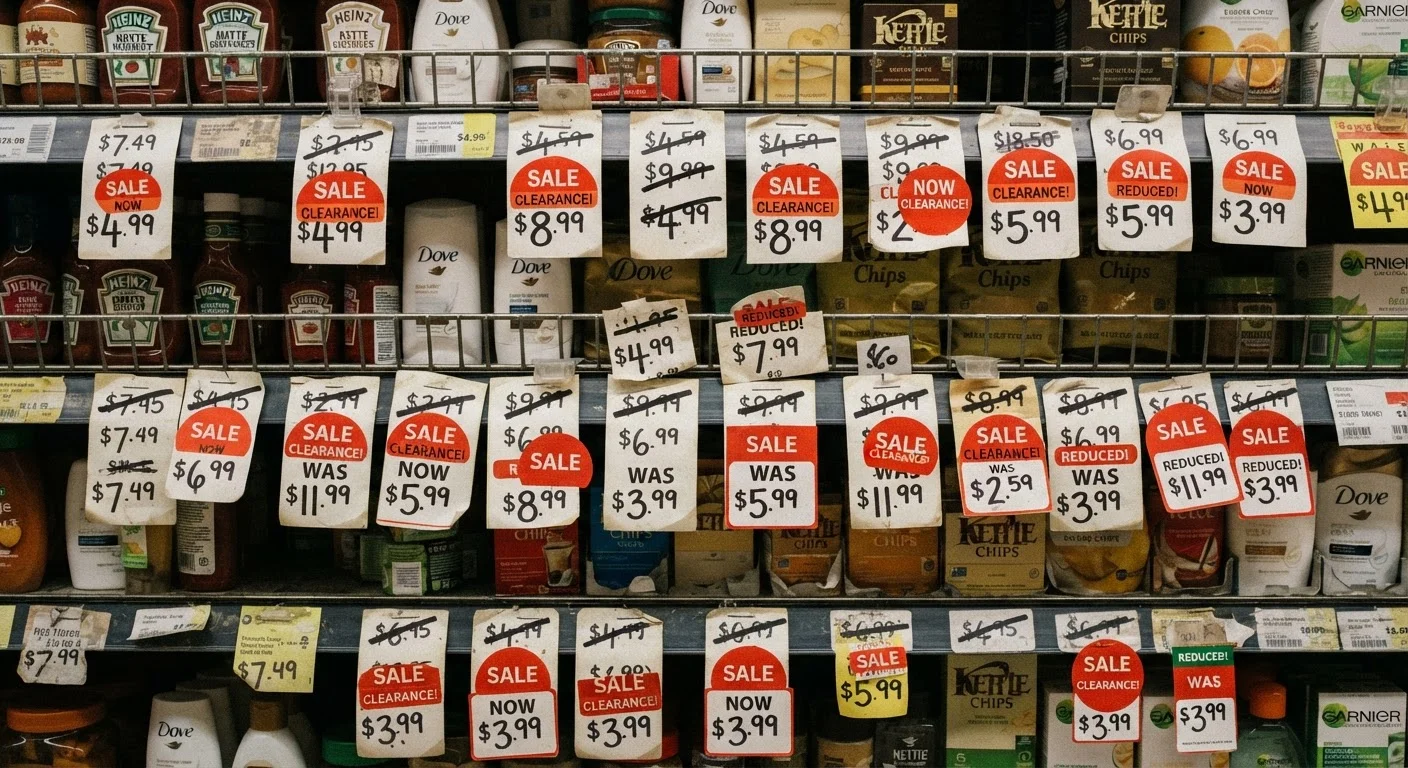
Anchoring: The First Number Wins
Anchoring is one of the most studied effects in decision-making research. When you see a number first - a listed 'original' price, a competitor's figure, or even a random reference point - it influences every comparison you make afterward. Retailers rely on this heavily.
A jacket marked down from $320 to $180 feels like a deal. A different jacket simply priced at $180 does not - even if both are identical in quality and actual market value. The only difference is that first number, and how it shapes your sense of what's reasonable.
This same dynamic shows up in real estate listing strategy, where an initial asking price anchors buyer expectations and shapes negotiation outcomes. In retail, the mechanism is identical - the anchor sets the reference frame, and everything else is measured against it.
To counter anchoring, ask yourself: if this item had no crossed-out price beside it, would I still consider it worth what I'm paying?
Reset Your Reference Point Before Buying
When you see a crossed-out price, mentally remove it and ask: would I pay what's being charged right now, based solely on what I know about this product? If the answer is uncertain, research what the item typically sells for across multiple retailers before deciding. Price-history browser extensions can show you whether a 'sale' price is actually the standard price in disguise.
Phantom Discounts and Reference Price Manipulation
A phantom discount is a markdown from a price that was never meaningfully in play. The 'original' price may have been listed briefly, or only in limited locations, or it may be a manufacturer's suggested retail price (MSRP) that virtually no one ever paid. The discount looks real because the math is accurate - but the baseline is fictional.
This is distinct from genuine markdowns where a product was broadly sold at the higher price for an extended period. The difference matters because your sense of savings is built on that reference point.
The sale season myth problem runs on phantom discounts: the 'limited time offer' often reflects a price that was never the real one. Price-tracking tools can reveal whether a listed 'original' price has ever actually been charged - and for how long.
~40%
Shoppers who track prices before purchasing
Consumer surveys consistently show a minority of shoppers use price-tracking tools, meaning most decisions rely on in-store or on-page reference prices - the very figures most susceptible to anchoring.
3x
Decoy effect influence on option selection
Academic research in behavioral economics has found that introducing a decoy option can shift consumer preference toward the target option by a factor of roughly three compared to two-option scenarios.
MSRP
Reference price often used in phantom discounts
Manufacturer's Suggested Retail Price is frequently used as the 'original' price in markdown displays, even though most products are rarely or never sold at that level in mainstream retail channels.
The Decoy Effect: When a Third Option Changes Everything
Imagine a streaming service offers two plans: Basic at $8/month and Premium at $16/month. Many customers choose Basic. Now add a third option - Standard at $15/month with slightly fewer features than Premium. Suddenly, Premium looks like an obvious deal for just a dollar more. That Standard tier is a decoy: it exists not to be chosen, but to reframe Premium as clearly superior.
This is the decoy effect, and it's deliberately engineered into product lineups, subscription tiers, coffee sizes, and meal bundles. The goal is to make one option look dominant by positioning an inferior alternative nearby.
You can spot decoys by ignoring relative comparisons and asking which option you'd choose if the others didn't exist. Price versus value thinking helps here: focus on whether what you're getting meets your actual needs at an acceptable price, rather than whether it 'beats' another option in the lineup.
Bundle Pricing: Convenience That Can Cloud Judgment
Bundles feel efficient. Pay one price, get several items. But bundling can obscure per-unit costs in ways that make evaluation difficult. When you can't price out each component separately, you lose the ability to judge whether the total is actually reasonable.
Retailers also use bundles to move slower inventory by pairing it with in-demand items. The flagship product you wanted subsidizes products you might not have chosen on their own.
Unit pricing logic applies here too: when possible, identify what you're paying per item or per unit within the bundle and compare it to standalone prices. If you can't isolate that figure, treat the bundle with the same scrutiny you'd give any opaque price.
This doesn't mean bundles are always bad - some do reflect genuine consolidation savings. But 'convenient' is not the same as 'economical,' and the two often get conflated in bundle marketing.
This article is for general informational and educational purposes only. It does not constitute financial, legal, or consumer protection advice. Readers should verify pricing claims independently and consult relevant consumer protection resources in their jurisdiction.