Why Certification Labels Deserve More Scrutiny
Walk through any grocery aisle or scroll through an online marketplace, and you'll encounter dozens of labels promising safety, sustainability, or ethical sourcing. Some represent genuine, independently verified standards. Others are little more than marketing graphics a company designed and applied to its own products. The difference matters - both for your wallet and for the claims you're trusting.
The core distinction is straightforward: a credible certification involves a third party - an organization separate from the manufacturer - that sets measurable standards, conducts audits or testing, and can revoke the certification if a product fails. A self-awarded label involves none of that. The company simply decides it qualifies and prints a seal.
This doesn't mean every unlabeled product is inferior, or that every certified product is worth a premium. But understanding what a label actually represents gives you a more honest basis for comparison. For a broader look at how marketing language is constructed to feel authoritative without being verifiable, see our piece on empty marketing superlatives.
USDA Organic - Meaningful, with Caveats
The USDA Organic seal is one of the more rigorous government-backed certifications available to American consumers. It requires third-party verification by an accredited certifying agent, prohibits most synthetic pesticides and fertilizers, and mandates recordkeeping that can be audited. Farms and processors must be recertified annually.
The caveat: "organic" addresses how something was grown or processed - not nutritional content, taste, or environmental impact beyond the farm gate. A product can be certified organic and still be heavily processed. Also note that "made with organic ingredients" (requiring 70% organic content) is a weaker standard than the full USDA Organic seal, which requires 95% or more.
USDA Organic requires annual third-party audits - one of the most verifiable food seals available.
ENERGY STAR - Reliable for Appliances and Electronics
Administered by the U.S. Environmental Protection Agency, ENERGY STAR sets efficiency thresholds that products must meet through testing conducted at EPA-recognized laboratories. Products are listed in a public, searchable database, making verification straightforward. The program covers appliances, lighting, HVAC systems, electronics, and more.
One thing to keep in mind: the threshold for qualification varies by category, and some product types have more demanding requirements than others. A product labeled ENERGY STAR isn't necessarily the most efficient option in its class - it meets the minimum qualifying standard. Use the program's online product finder to compare efficiency ratings within a category rather than treating the label as a single quality tier.
ENERGY STAR products are verified through EPA-recognized lab testing and listed in a public database.
NSF Certification - Important for Health-Adjacent Products
NSF International is an independent, accredited organization that tests and certifies products across food equipment, water filtration, dietary supplements, and other health-related categories. For water filters in particular, NSF/ANSI standards (such as Standard 53 for contaminant reduction) specify exactly which contaminants a filter must reduce and by how much. A filter claiming to reduce lead under NSF/ANSI 53 has been tested against that specific benchmark.
This granularity matters. Generic claims like "filters contaminants" carry no standard meaning. An NSF mark tied to a specific standard tells you what was actually tested. Verify certification on NSF's public database before assuming a product's claims are independently backed.
NSF marks are tied to specific tested standards - look up the exact standard number for full context.
"Clinically Tested" and "Dermatologist Approved" - Largely Unregulated
These phrases appear constantly on personal care and cosmetic products, but neither term has a standardized regulatory definition in the U.S. "Clinically tested" can mean anything from a rigorous double-blind study to a small consumer perception survey. "Dermatologist approved" may mean one dermatologist was paid as a consultant - or simply that the company surveyed a handful of practitioners.
The absence of a named certifying body is the tell. If the label doesn't specify who conducted the testing, under what protocol, or where results are publicly available, the claim is essentially self-reported. That doesn't mean the product is unsafe or ineffective - it means the label itself provides no meaningful independent signal.
Without a named third-party and published protocol, 'clinically tested' is a self-reported claim.
Rainforest Alliance and Fair Trade USA - Meaningful but Structurally Different
Both programs certify supply chain and sourcing practices, but they use different models. Fair Trade USA focuses on price minimums and premiums paid to producers, along with labor and environmental standards. Rainforest Alliance emphasizes farm management practices, biodiversity protection, and worker welfare - with a graduated compliance approach rather than binary pass/fail.
Neither is a guarantee of a perfect supply chain, but both involve third-party audits and publicly available standards. The Rainforest Alliance frog seal now appears on products meeting a range of compliance levels, so reading the organization's current standard documentation gives a more accurate picture than assuming the seal represents a single fixed benchmark. For shoppers thinking more broadly about ethical sourcing language, understanding ethical consumption labels is worth reading alongside this.
Rainforest Alliance and Fair Trade both involve third-party audits, but their standards differ structurally.
UL (Underwriters Laboratories) - A Safety Standard Worth Trusting
UL is one of the oldest and most established independent safety certification organizations in the United States. When an electrical product carries a UL mark, it has been tested against published safety standards and the manufacturer's production process is subject to periodic follow-up inspections. UL marks are relevant for electronics, appliances, extension cords, lighting, and similar products.
Counterfeit UL marks exist, particularly on imported goods sold through informal channels. You can verify a product's UL certification through UL's Product iQ database. For higher-stakes purchases - space heaters, power strips, EV chargers - this verification step is worth the two minutes it takes.
UL certification includes periodic production inspections - and counterfeits can be verified against UL's public database.
Generic "Eco" Seals - High Variation, Low Accountability
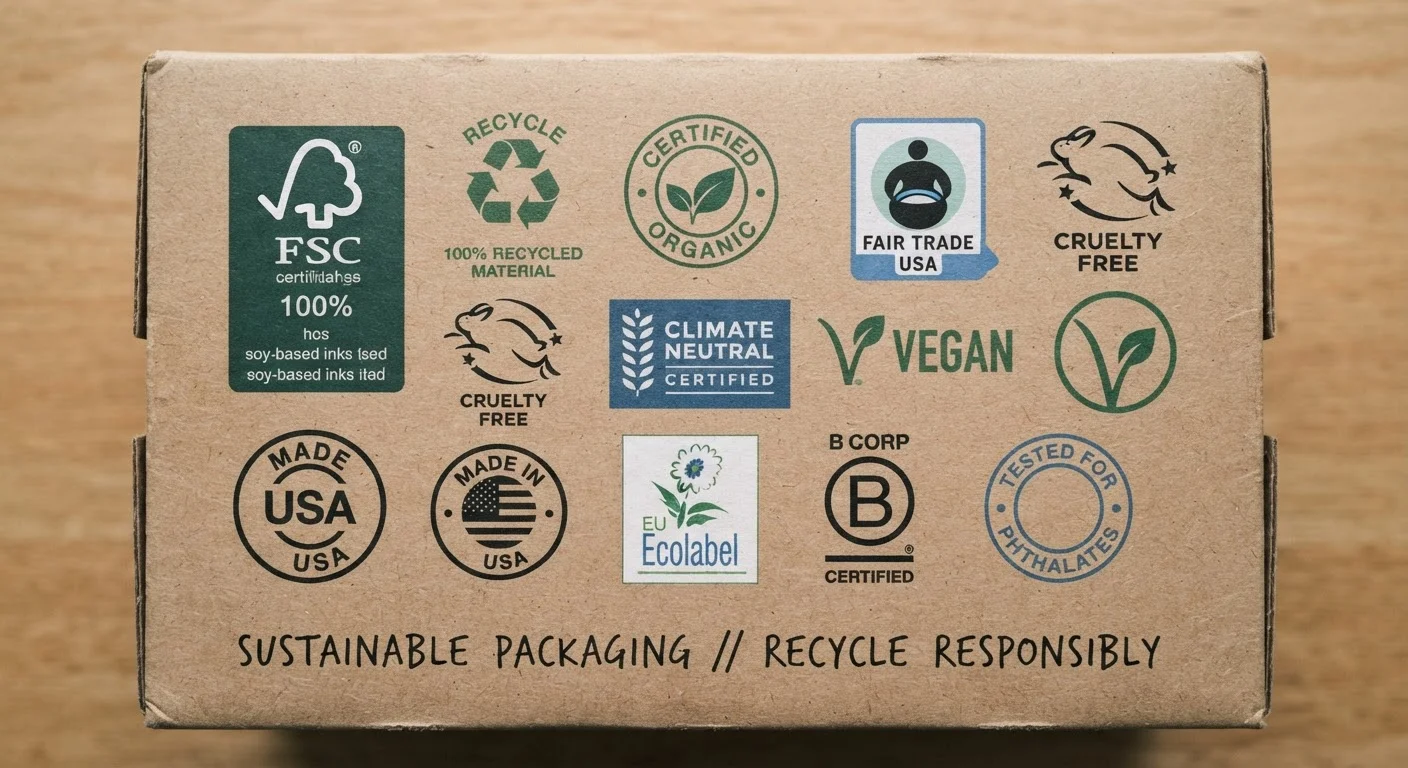
Labels like "eco-certified," "green approved," or "sustainably sourced" with a leaf or globe graphic but no named certifying body are essentially unverifiable. There is no regulatory framework preventing a company from creating its own green-looking seal and applying it to products. These graphics are designed to create an impression of external validation that doesn't exist.
This is a central pattern in greenwashing - using visual cues that mimic legitimate certifications without the underlying accountability structure. Our article on spotting misleading green product claims breaks down the most common design and language tactics used to simulate credibility.
A green logo without a named certifying body is a graphic, not a certification.
How to Quickly Vet a Label You Don't Recognize
You don't need to memorize every certification program. A reliable shortcut: search the name of the certifying body directly and look for a public registry or searchable database of certified products. Legitimate programs - ENERGY STAR, NSF, Rainforest Alliance, and others - let you verify whether a specific product or company actually holds the credential. If a seal leads to a dead-end website, a brand's own page, or no searchable record at all, treat it with skepticism.
Verify Before You Trust
For any unfamiliar certification seal, search the certifying organization's name directly and look for a public product registry. Legitimate programs like NSF, UL, and ENERGY STAR maintain searchable databases where you can confirm a specific product is genuinely listed. If you can't verify the claim independently, treat the label as unconfirmed marketing rather than a verified credential.
Labels that reference standards without naming a certifying body are also a signal worth noting. Phrases like "meets EPA guidelines" or "formulated to dermatologist standards" describe internal claims, not independent verification. For more guidance on parsing environmental claims specifically, our article on greenwashing and green product claims walks through the most common patterns. And if you're evaluating broader label language around sourcing and ethics, what ethical consumption means in practice adds useful context.