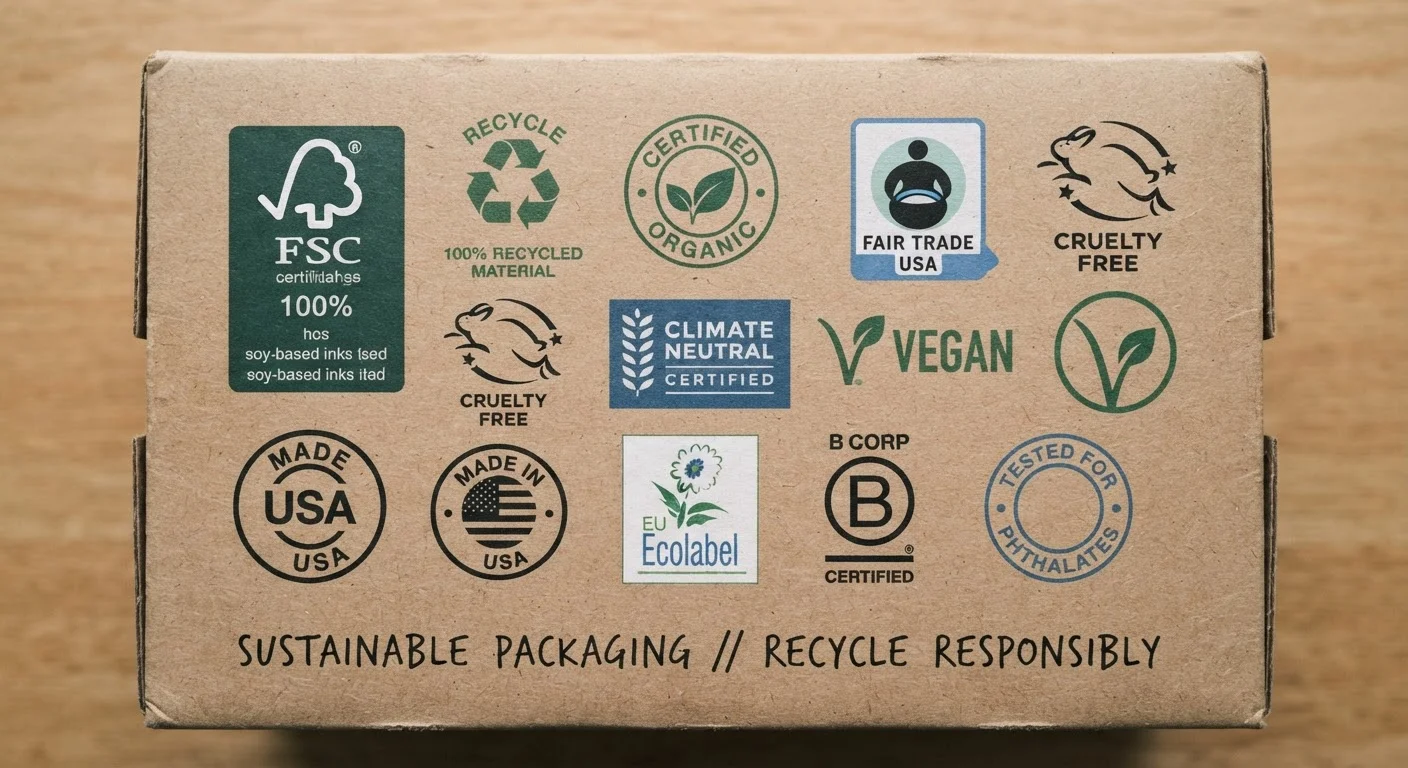

What Greenwashing Actually Looks Like
Greenwashing refers to the practice of overstating or misrepresenting a product's environmental attributes to appeal to eco-conscious consumers. It ranges from outright false claims to technically true statements that are deliberately misleading in context. The U.S. Federal Trade Commission (FTC) publishes guidance known as the Green Guides to address deceptive environmental marketing - but enforcement is inconsistent, and the burden of scrutiny often falls on consumers.
The most common forms aren't bold lies. They're strategic omissions, unqualified superlatives, and imagery designed to imply environmental virtue without backing it up. A brown cardboard label with leaf graphics signals nothing about a product's actual supply chain, manufacturing process, or end-of-life disposal impact. Understanding this gap between appearance and substance is the first step to shopping more critically. For a broader framework on evaluating product claims generally, see the Consumer's Field Guide to Evaluating Any Product.
The Language of Vague Environmental Claims
Certain words appear constantly on product packaging without carrying any enforceable meaning. 'Natural,' 'eco-friendly,' 'green,' 'sustainable,' and 'clean' are among the most frequently used - and least regulated - terms in consumer marketing. None have a fixed legal definition that manufacturers must meet before using them.
Demand specificity - reject unqualified environmental adjectives
Vague terms like 'eco-friendly' or 'green' have no legal definition and no enforced minimum standard. A claim only becomes useful when it specifies what attribute is being described, to what degree, and how it was measured.
Check whether a claim covers the whole product or just one component
Selective framing is a hallmark of greenwashing. A company might spotlight a single green attribute - recyclable packaging - while the rest of the product's lifecycle has significant environmental costs.
Look for third-party certification marks with publicly available standards
Independent certification programs require manufacturers to meet defined criteria and submit to audits. Self-declared icons provide no such accountability and can be designed to mimic credible certifications.
Research the claim beyond the label
Many environmental assertions are technically defensible in narrow terms but misleading in practice. A company's sustainability report, public regulatory filings, or independent reviews can reveal the fuller picture.
Notice what the label doesn't mention
Strategic omission is as common as outright exaggeration. A brand that highlights one attribute while staying silent on others is often drawing attention away from weaker areas.
Even more specific-sounding terms warrant close reading. 'Made with recycled materials' could mean 5% post-consumer content or 95% - the label rarely clarifies. 'Biodegradable' is only meaningful when conditions are specified: most plastics labeled as such require industrial composting facilities, not a home bin or a landfill. For a deeper look at how product terminology is constructed to impress rather than inform, see what product specifications actually tell you.
Certifications That Carry Real Weight
Not all green labels are meaningless - some represent genuine independent verification with defined standards and auditing requirements. The key distinction is whether a claim is self-declared by the manufacturer or certified by a credible, independent third party.
Self-Declared vs. Third-Party Certified
A self-declared claim is one the manufacturer makes about its own product without independent verification - it carries only as much credibility as the company itself. A third-party certification means an external organization with defined standards has reviewed and approved the claim. When in doubt, the FTC Green Guides recommend that unqualified environmental claims should be avoided by marketers unless they can be substantiated with reliable evidence. Consumers can use the same standard when evaluating labels.
Programs like USDA Organic, Energy Star (for appliances), FSC (Forest Stewardship Council for wood and paper products), and Leaping Bunny (cruelty-free) require producers to meet documented criteria and undergo periodic review. These differ meaningfully from proprietary icons a company designs and applies to its own products. When evaluating any certification mark, it's worth asking: Who sets the standard? Who does the auditing? Are the criteria publicly available? The article Certification Labels on Products: Which Ones Are Meaningful and Which Aren't breaks this down in detail.
Practical Practices for Cutting Through the Noise
Approaching green claims systematically - rather than emotionally - puts you in a stronger position as a consumer. This isn't about cynicism; many companies do make genuine, substantiated environmental efforts. The goal is to distinguish those from claims designed primarily to convert sales.
It also helps to consider the full picture. A product might advertise recycled packaging while the item inside is made from virgin petrochemicals with a short lifespan - meaning the net environmental impact is still high. This concept, sometimes called 'partial greenwashing,' is addressed in the FTC's Green Guides and is one reason the agency recommends claims be specific and qualified. For context on how terms like 'sustainable' operate across the broader marketplace, see what 'ethical consumption' really means for everyday shoppers.