
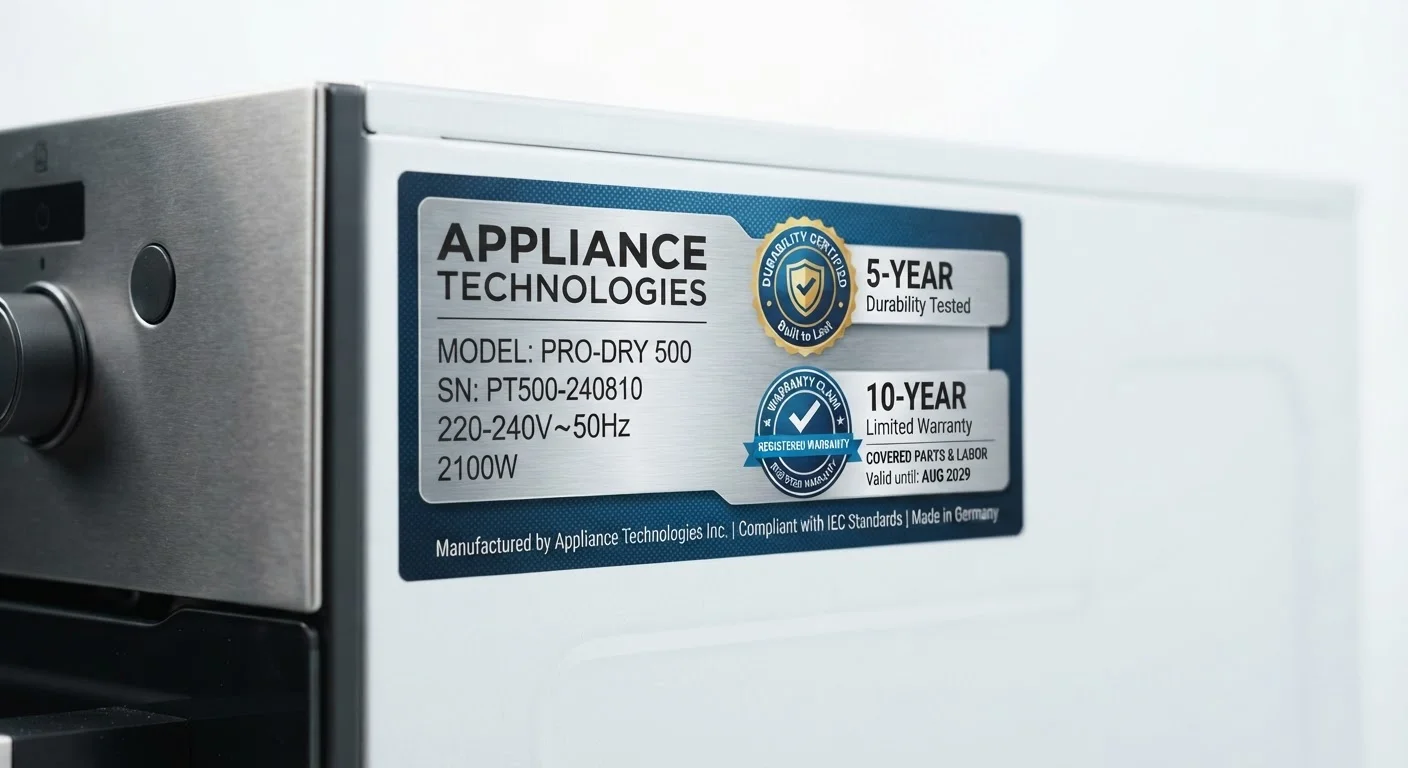
Why Durability Claims Are Rarely What They Seem
Walk down any appliance or hardware aisle and you'll see phrases like "built to last," "industrial strength," and "lifetime durability" on nearly every shelf. These aren't engineering specifications - they're marketing language, and for most consumer product categories, they carry no regulatory weight.
The Federal Trade Commission can challenge claims that are demonstrably false or deceptive, but general durability language occupies a wide gray area. Terms like "heavy duty" or "commercial grade" have no universal legal definitions in most product categories, which means any manufacturer can apply them without independent verification.
This matters because consumers routinely rely on packaging claims when making purchasing decisions. Understanding that these descriptors are persuasion tools - not tested guarantees - is the first step toward evaluating products more accurately. See our guide to empty marketing superlatives for a broader look at how credibility language works in advertising.
Warranty Periods vs. Actual Product Lifespan
One of the most common misconceptions is treating warranty length as a proxy for how long a product will last. A warranty is a legal commitment from a manufacturer to repair or replace a defective product within a specific window - it is not a performance prediction.
A manufacturer offering a one-year warranty on a small appliance isn't claiming the product will fail at month thirteen. Equally, a five-year warranty doesn't mean the product is built for a decade of reliable use. Warranty terms are shaped by business calculations around return rates, cost of claims, and competitive positioning as much as engineering confidence.
Check Exclusion Clauses Before Assuming Coverage
Before treating a warranty as evidence of build quality, read what it excludes. Most limited warranties do not cover normal wear, cosmetic damage, or use outside stated conditions. A short list of exclusions and a clear repair or replacement process is often more valuable than a long warranty period with vague terms.
What warranties actually tell you is what the manufacturer won't cover and under what conditions. Exclusion clauses - covering normal wear, misuse, or non-original parts - are often as informative as the coverage itself. For a plain-English breakdown of warranty language, see our article on what manufacturers actually promise you.
What Actually Predicts How Long a Product Lasts
Reliable lifespan indicators are found in the details manufacturers are less likely to advertise prominently. Materials composition, construction method, component sourcing, and tolerance engineering all have more predictive value than a tagline.
- Materials specifications: Gauge of steel, thread count, polymer grade, and similar data points are concrete and comparable across products.
- Third-party certifications: Organizations like UL, ASTM International, or ENERGY STAR test to defined standards. Certification by these bodies is more meaningful than self-declared claims.
- Repairability: Products designed with replaceable components or standard parts typically support longer service lives than sealed or proprietary-component designs.
- Use-condition assumptions: Most stated lifespans assume average or light use. Heavy use, environmental exposure, or off-label applications can significantly shorten real-world performance.
This framework connects to a broader approach to product evaluation covered in The Consumer's Field Guide to Evaluating Any Product.
~80%
Consumers who factor durability into purchase decisions
According to surveys by consumer research organizations, the large majority of shoppers say durability is a significant factor in buying decisions, yet most report difficulty verifying those claims.
2-3x
Lifespan gap between design life and actual service life
Product engineers and consumer researchers have noted that real-world service life commonly falls 50-60% short of theoretical design life due to use conditions and maintenance gaps.
No standard
Regulatory definition for 'heavy duty' labeling
Most consumer product categories in the U.S. have no federally mandated definition for common durability descriptors, leaving interpretation to manufacturers.
Reading Lifespan Data You Can Actually Trust
Consumer advocacy organizations and independent testing labs - which purchase products without manufacturer involvement and subject them to standardized testing - produce some of the most reliable durability data available to consumers. Long-term owner reviews in verified purchase communities, particularly those gathered over twelve months or more, also provide real-world service-life evidence that short-term impressions cannot capture.
Be cautious about testimonials on brand websites or aggregated star ratings that skew heavily toward early-use impressions. A product may perform well in the first weeks and degrade significantly over months of use. Prioritize sources that track products over time and distinguish between initial quality and long-term reliability.
For products making environmental or sustainability claims, lifespan is directly relevant - a product marketed as eco-friendly but designed for rapid obsolescence undermines that framing. Our guide to evaluating green product claims addresses how durability intersects with sustainability marketing.