What Happens Inside the Mill
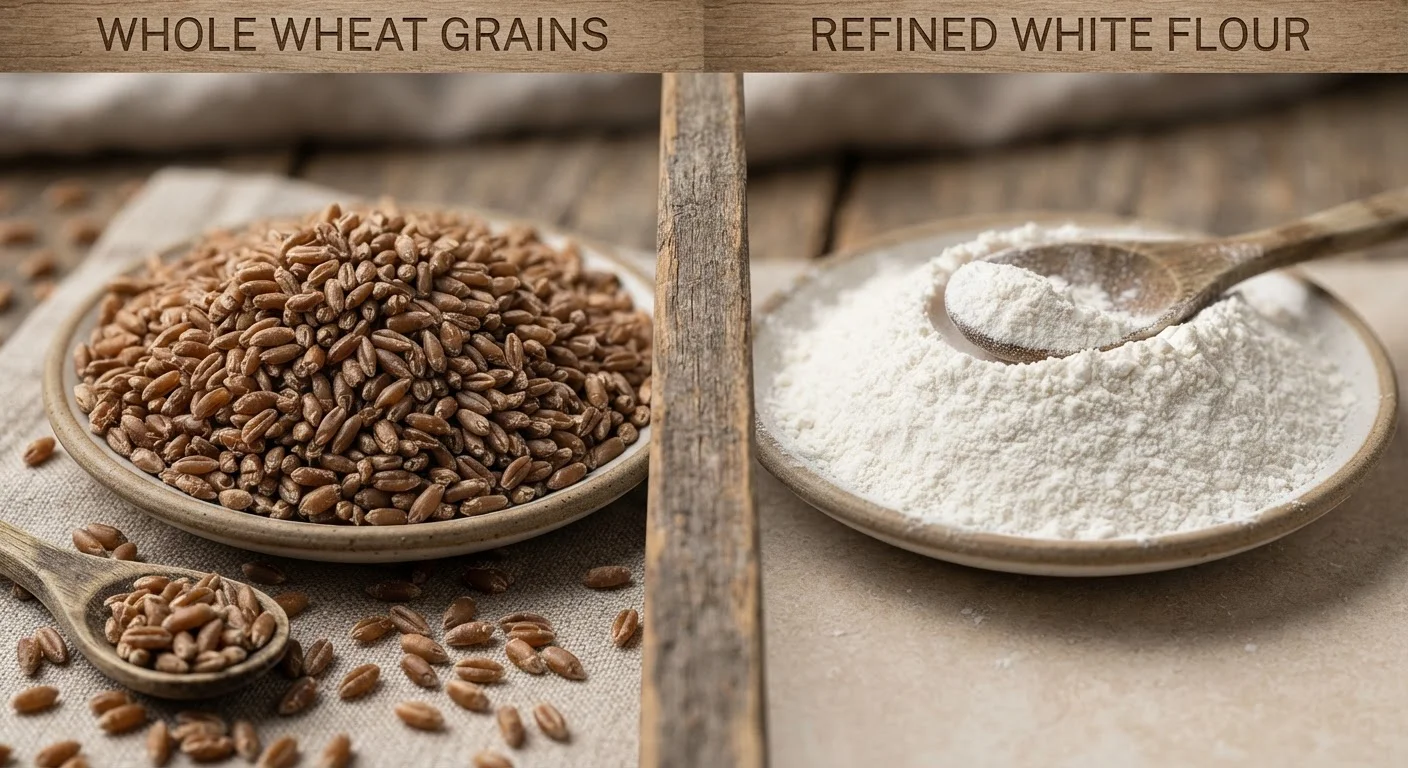
A grain kernel has three distinct layers: the outer bran, the central endosperm, and the small but nutrient-dense germ. Whole grains, by definition, retain all three. Refined grains do not.
During milling, the bran and germ are mechanically removed, leaving predominantly the starchy endosperm. This process extends shelf life and produces the smoother texture most consumers associate with white flour or white rice. But it comes at a significant nutritional cost. According to the Whole Grains Council, refining can remove roughly 25% of a grain's protein and substantial portions of at least 17 key nutrients, including dietary fiber, iron, zinc, and B vitamins such as thiamine, riboflavin, niacin, and folate.
Enrichment - a practice mandated in the United States for many refined grain products - adds back iron and four B vitamins. This partially closes the gap on specific deficiencies, but it does not restore fiber, magnesium, potassium, or the array of phytochemicals found naturally in the bran and germ.
| Criterion | Whole Grains | Refined Grains |
|---|---|---|
| Grain layers retained | Bran, endosperm, and germ | Endosperm only |
| Dietary fiber content | High - naturally occurring | Low - mostly removed |
| B vitamins | Naturally present in full spectrum | Partially restored via enrichment |
| Minerals (magnesium, zinc) | Present in meaningful amounts | Significantly reduced; not enriched |
| Glycemic response | More gradual blood sugar rise | Faster, higher blood sugar rise |
| Shelf life | Shorter - germ oils can go rancid | Longer - stable without germ |
| Texture and palatability | Denser, heartier texture | Lighter, softer texture |
| Phytochemicals and antioxidants | Naturally rich in polyphenols | Substantially reduced |
How the Body Responds Differently
The structural differences between whole and refined grains have measurable effects on digestion and metabolism. Fiber from the bran slows the breakdown of starch into glucose, which moderates the rise in blood sugar after a meal. Refined grains, stripped of this fiber, are digested more rapidly, producing a faster and higher glycemic response.
Large-scale observational research - including analyses drawing on data from cohorts such as the Nurses' Health Study and Health Professionals Follow-up Study - has associated higher whole grain intake with reduced risks of type 2 diabetes, cardiovascular disease, and certain digestive disorders. These are associations, not proof of direct causation, and individual responses can vary based on overall dietary pattern, gut microbiome composition, and genetics.
~25%
Protein lost during typical grain refining
The Whole Grains Council estimates refining removes roughly a quarter of a grain's protein along with the majority of its fiber and many micronutrients.
≥50%
Recommended whole grain share of daily grain servings
The U.S. Dietary Guidelines for Americans recommend that at least half of all daily grain servings come from whole grain sources.
~21-38g
Daily fiber recommended for most adults
The National Academies of Sciences set adequate intake levels for dietary fiber at around 25g for adult women and 38g for adult men, amounts most Americans fall short of.
The DGA, published jointly by the U.S. Department of Agriculture and Department of Health and Human Services, recommends that at least half of all grain servings come from whole grain sources. This guidance reflects decades of accumulated evidence, not a single study.
Reading Labels and Making Practical Swaps
Marketing language on grain products can be misleading. Terms like multigrain, stone-ground, or wheat bread do not guarantee whole grain content. The most reliable indicator is the ingredient list: the first ingredient should read "whole wheat," "whole oats," "whole grain corn," or another whole grain, with the word whole explicitly present.
For a deeper walkthrough of how to interpret ingredient lists and nutrition panels, see our guide to reading a Nutrition Facts label.
Practical substitution does not require an overnight overhaul. Common starting points include choosing oatmeal over sugary refined cereals, replacing white rice with brown or wild rice, and selecting whole wheat pasta. Even these incremental changes contribute meaningful additional fiber over the course of a week.
It is also worth understanding how grain processing fits into the broader landscape of food production. Ultra-processed foods frequently rely on refined grain ingredients alongside additives and preservatives - a distinction that matters beyond the grain type alone.
This article is for general informational and educational purposes only. It is not medical or dietary advice. Individuals with specific health conditions, digestive concerns, or therapeutic dietary needs should consult a registered dietitian or qualified healthcare professional before making significant changes to their diet.