What You're Actually Looking At
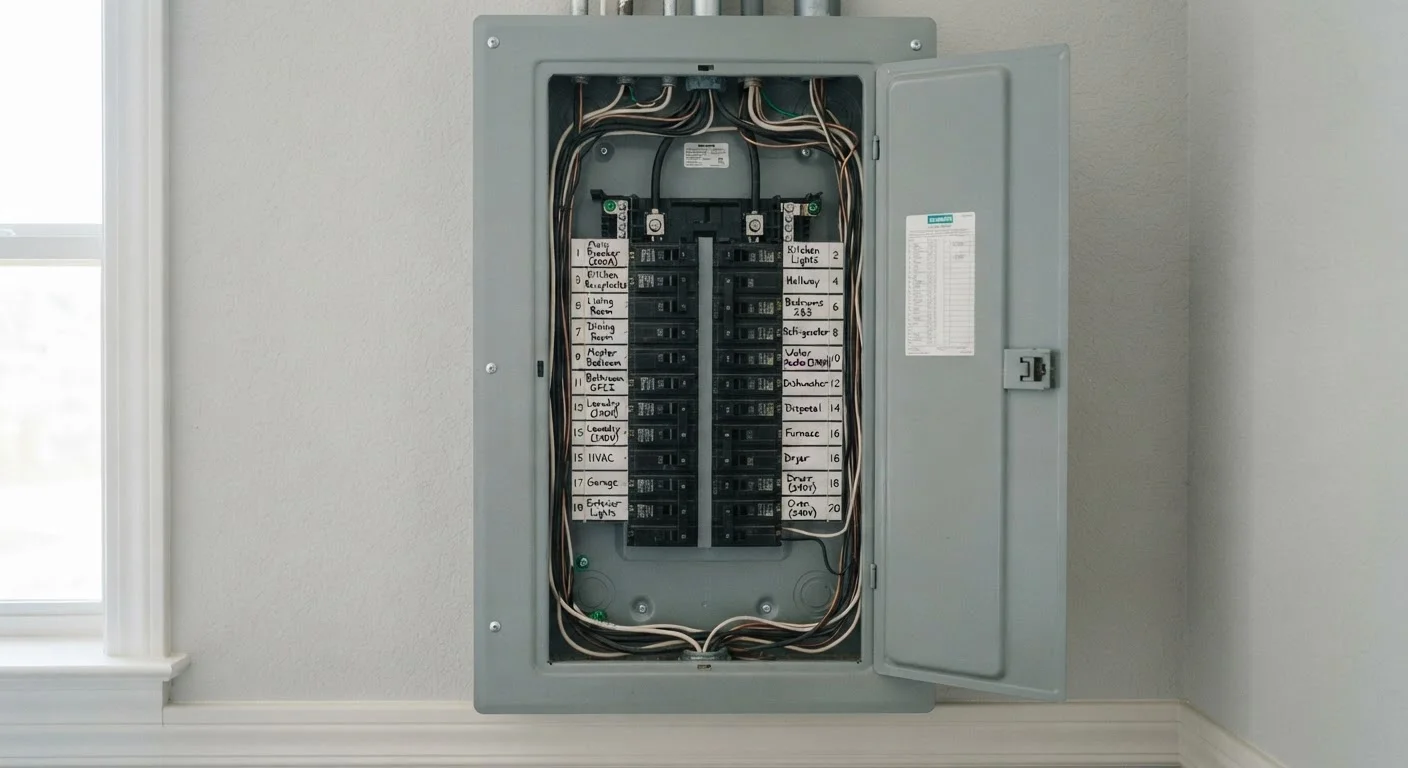
Open the door of your electrical panel and you'll see a metal enclosure filled with rows of switches - those are your circuit breakers. At the top sits the main breaker, a wide double-pole switch that controls power to the entire panel. Below it are the branch circuit breakers, each controlling a separate circuit in your home.
Each breaker has a number stamped on it - 15, 20, 30, or higher. That number is the amperage rating: the maximum electrical current that circuit can safely carry before the breaker trips. A 15-amp breaker typically protects standard lighting circuits; 20-amp breakers handle outlets in kitchens, bathrooms, and laundry areas; larger ratings serve dedicated appliances like electric dryers or HVAC equipment.
Breakers come in two forms: single-pole (one switch, serving 120-volt circuits) and double-pole (two switches joined together, serving 240-volt circuits for larger appliances). Double-pole breakers take up two slots in the panel.
Decoding the Labels
A well-labeled panel is one of the most useful tools in your home. Labels identify which breaker controls which area - "Master Bedroom," "Kitchen Outlets," "Garage," and so on. If your panel labels are missing, incomplete, or illegible, creating an accurate circuit map should be a priority.
To map your circuits without a helper, plug a lamp or radio into an outlet, then switch breakers off one at a time until the device goes dark. Label that breaker, restore power, and repeat. For hardwired items like ceiling lights, a non-contact voltage tester - a handheld tool available at hardware stores - lets you confirm whether power is present without touching any wiring.
Document Your Circuit Map Now
Once your panel is fully labeled, photograph it and store the image somewhere accessible - on your phone and taped inside the panel door. This reference is invaluable during outages, renovations, or emergencies when you need to quickly identify and isolate a specific circuit.
Once your panel is fully labeled, photograph it. Store the image on your phone and tape a printed copy inside the panel door. This reference is invaluable during outages, renovations, or emergencies.
Reading Warning Signs You Should Not Ignore
Your panel communicates more than circuit locations - it also shows you when something is wrong. Here are conditions that require attention:
- A breaker that won't reset or immediately trips again: This points to a persistent overload or a fault in the circuit wiring, not just a temporary issue.
- Rust, moisture, or corrosion inside the panel: Water intrusion near electrical components is a serious hazard.
- Scorch marks, a burning smell, or a buzzing sound: These are signs of arcing or overheating - call a licensed electrician immediately.
- A warm panel door or hot breaker: Some warmth is normal, but significant heat suggests an overloaded circuit or loose connection.
These are observation and reporting tasks - not repair tasks. The interior wiring of an electrical panel carries live voltage even when the main breaker is off, because the utility feed lines remain energized. Never touch wiring inside your panel. Any work beyond resetting a tripped breaker belongs with a licensed electrician.
The Limits of DIY - and Why They Matter
Understanding your panel empowers you to troubleshoot outages, plan appliance loads, and communicate clearly with electricians. It does not qualify you to add circuits, replace breakers, or modify wiring. Panel work - beyond resetting a breaker - is regulated in virtually every U.S. jurisdiction, requires permits, and must be inspected. Our guide to permits and home improvement inspections explains when permits are typically required and what the inspection process looks like.
If your home has an older panel - particularly one with known safety concerns such as certain fuse-based systems or recalled panel models - have it evaluated by a licensed electrician. An outdated or undersized panel may not be able to meet the demands of modern appliances and home systems.
Reading your panel is about informed awareness, not hands-on intervention. That distinction keeps you safe and keeps your home's electrical system reliable.
This article is for general informational purposes only. Electrical work involving panel wiring or modifications should always be performed by a licensed electrician. Verify permit and code requirements with your local building department before undertaking any electrical project.