Registration Terms
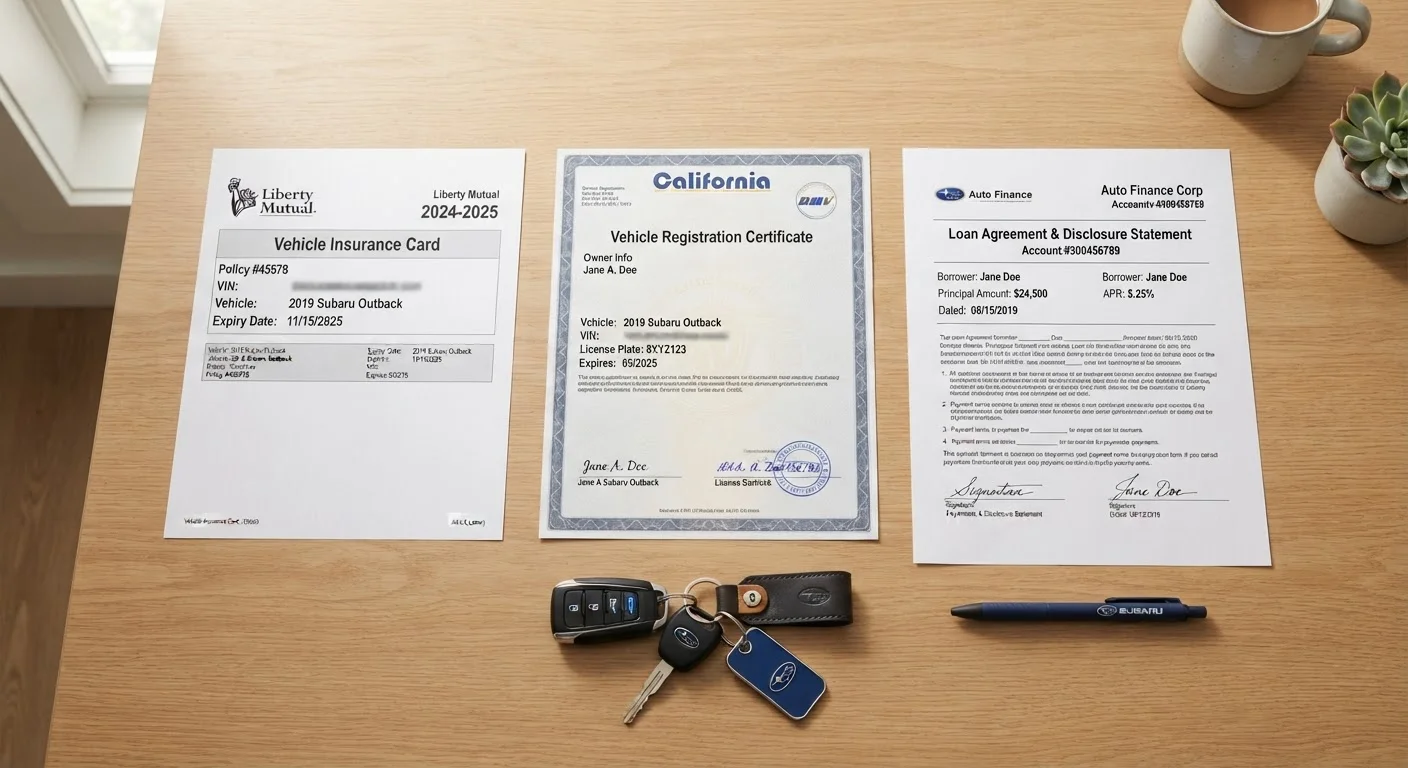
Every vehicle on public roads must be registered with a state agency - usually the Department of Motor Vehicles (DMV) or an equivalent office. Here are the key terms you'll encounter.
Title
The legal document that establishes vehicle ownership. A lender holds a lien on the title when the car is financed; the title transfers cleanly to the owner when the loan is paid off.
VIN
A 17-character Vehicle Identification Number unique to every car. It's used to verify ownership, check recall history, and confirm accident records.
Premium
The regular payment - monthly or semi-annual - you make to maintain your auto insurance policy.
Deductible
The amount you pay out of pocket when filing an insurance claim before coverage kicks in. A higher deductible typically lowers your premium.
Liability Coverage
Insurance that pays for damage or injury you cause to others. Most states require a legal minimum, but it does not cover your own vehicle.
Gap Insurance
Optional coverage that pays the difference between your loan balance and the vehicle's actual cash value if the car is totaled or stolen.
APR
Annual Percentage Rate - the yearly cost of a loan including interest and fees, expressed as a percentage. Useful for comparing loan offers side by side.
Lien
A lender's legal claim on your vehicle as collateral for an auto loan. The lien is released when the loan is fully repaid.
Amortization
The schedule by which loan payments are divided between interest and principal over the life of the loan. Early payments are mostly interest.
Registration
The state-issued authorization to operate a vehicle on public roads, typically renewed annually and tied to your license plate.
Title is the legal document proving who owns the vehicle. If you finance a car, the lender typically holds the title - or a lien on it - until the loan is paid off. Once you pay in full, the lender releases the lien and you receive a clean title.
Registration is your state's annual authorization to operate a specific vehicle on public roads. It's tied to your license plate and usually requires proof of insurance and payment of registration fees. Letting registration lapse can result in fines or your vehicle being flagged during a traffic stop.
VIN (Vehicle Identification Number) is a 17-character code unique to your car. It appears on your title, registration, dashboard, and insurance card. It's used to track recalls, accident history, and ownership transfers.
For a broader look at what documents and coverage you should review annually, see the annual car ownership audit - it walks through registration renewal alongside insurance and maintenance tasks.
Insurance Terms
Auto insurance policies are full of terms that affect what you actually pay - and what you're actually covered for. These are the ones that matter most.
Premium is the amount you pay for your insurance policy, typically monthly or every six months. It's determined by factors like your driving record, location, vehicle type, and coverage selections.
Deductible is the dollar amount you pay out of pocket before your insurance covers the rest of a claim. A higher deductible generally means a lower premium, and vice versa.
Liability coverage pays for damage or injuries you cause to others in an accident. Nearly every state requires drivers to carry a minimum amount. It does not cover damage to your own vehicle.
Comprehensive coverage pays for damage to your vehicle from non-collision events - theft, weather, falling objects, and similar incidents.
Collision coverage pays for damage to your vehicle from a crash, regardless of who was at fault.
Uninsured/underinsured motorist coverage protects you if you're hit by a driver who has no insurance or insufficient coverage to pay for your damages.
Gap insurance covers the difference between what you owe on a car loan and what the vehicle is worth if it's totaled. This matters most in the early years of a loan, when a car can depreciate faster than you pay down the balance.
Financing Terms
Taking out an auto loan involves a layer of financial terminology. Understanding these terms helps you evaluate loan offers more clearly.
Principal is the original amount borrowed - the purchase price minus any down payment or trade-in credit.
APR (Annual Percentage Rate) represents the yearly cost of borrowing, including the interest rate and certain fees. It allows you to compare loan offers on equal footing. A lower APR means less paid in interest over the life of the loan.
Loan term is the length of time you have to repay the loan, usually expressed in months (e.g., 48, 60, or 72 months). Longer terms lower your monthly payment but increase total interest paid.
Amortization describes how loan payments are structured over time. Early payments are weighted heavily toward interest; later payments go more toward the principal balance.
Lien is a legal claim a lender holds on your vehicle until the loan is repaid in full. You cannot legally sell a vehicle with an unresolved lien without satisfying the debt first.
If you're considering leasing instead of buying, the leasing mechanics guide explains residual value, money factor, and mileage caps in plain language.
This article is for general informational purposes only and does not constitute financial, legal, or insurance advice. Consult a licensed professional for guidance specific to your situation.