
How Credit Utilization Is Calculated
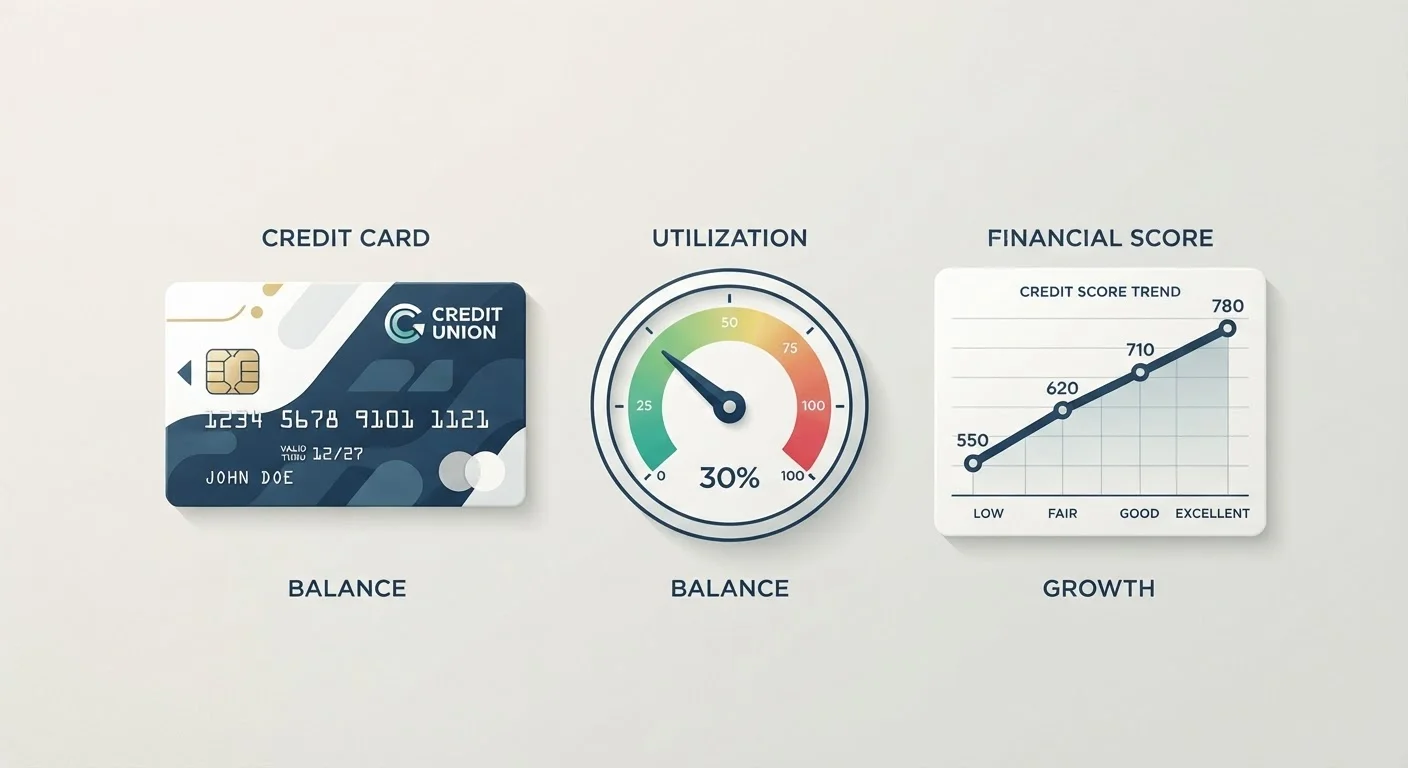
The math behind credit utilization is straightforward. Add up all outstanding balances on your revolving credit accounts, then divide that total by the sum of all your credit limits. Multiply by 100 to get a percentage.
Example: Three credit cards with limits of $3,000, $4,000, and $3,000 give you a combined limit of $10,000. If your balances are $600, $1,200, and $200 respectively - totaling $2,000 - your aggregate utilization is 20%.
Scoring models also evaluate each card individually. A card maxed at 95% utilization hurts your score even if the other two cards sit empty. This means spreading balances across cards rather than concentrating debt on one account can make a meaningful difference.
~30%
Weight of utilization in a FICO score
According to FICO's published scoring criteria, amounts owed - which includes utilization - is the second-largest factor in most FICO score calculations.
<30%
Commonly recommended utilization ceiling
Credit counselors and scoring educators widely cite staying below 30% per card and in aggregate as a practical threshold for protecting your score.
1 cycle
Time for paydown to appear in your score
Because utilization is based on currently reported balances, score changes from paying down debt typically appear within one billing cycle - roughly 30-45 days.
Why Lenders and Scoring Models Pay Close Attention
Credit utilization is the second-largest component in the widely used FICO scoring model, typically weighted at around 30% of your total score. Only payment history carries more influence.
From a lender's perspective, high utilization signals that a borrower may be over-reliant on credit or approaching the limits of their capacity to repay. A borrower consistently using 80% or more of their available credit looks riskier than one using 10%, even if both have spotless payment histories.
This is why reviewing your utilization is a core step before any major loan application. Our credit health checklist walks through the full range of factors lenders typically examine, with utilization prominently featured.
It is also worth noting that utilization is distinct from your debt-to-income ratio (DTI), which compares your monthly debt payments to your gross income. For mortgage lenders in particular, DTI often carries more weight than your credit score once you reach the application stage.
Common Misconceptions About Utilization
Many people assume that carrying a small balance each month - rather than paying in full - demonstrates responsible use and helps their score. This is a myth. Scoring models measure the balance reported by your lender, not whether you paid in full afterward. Carrying a balance only means paying interest; it does not improve your utilization standing.
Another widespread belief is that a high utilization record permanently damages your score. In reality, utilization has no memory. Once you pay down balances, the improved ratio is reflected in your next score update. This is very different from a late payment, which stays on your credit report for up to seven years.
For a deeper look at credit misconceptions - including whether checking your own score lowers it - see our article on common credit score myths.
Practical Ways to Lower Your Utilization
The most effective approach is to pay down existing balances. Even a partial paydown can move the needle meaningfully. If you cannot eliminate a balance immediately, consider paying more than the minimum each month to chip away at utilization over time.
Requesting a credit limit increase on an existing card - without increasing spending - mathematically lowers your utilization because the denominator grows while the numerator stays the same. Not all lenders will approve this without a hard inquiry, so ask whether a soft-pull option is available before requesting.
Timing your payments strategically also helps. Since lenders typically report your balance as of your statement closing date, making an extra payment just before that date ensures a lower number is sent to the credit bureaus that month.
This article is for general informational purposes only and does not constitute personalized financial or credit advice. Consult a qualified financial professional for guidance specific to your situation.