
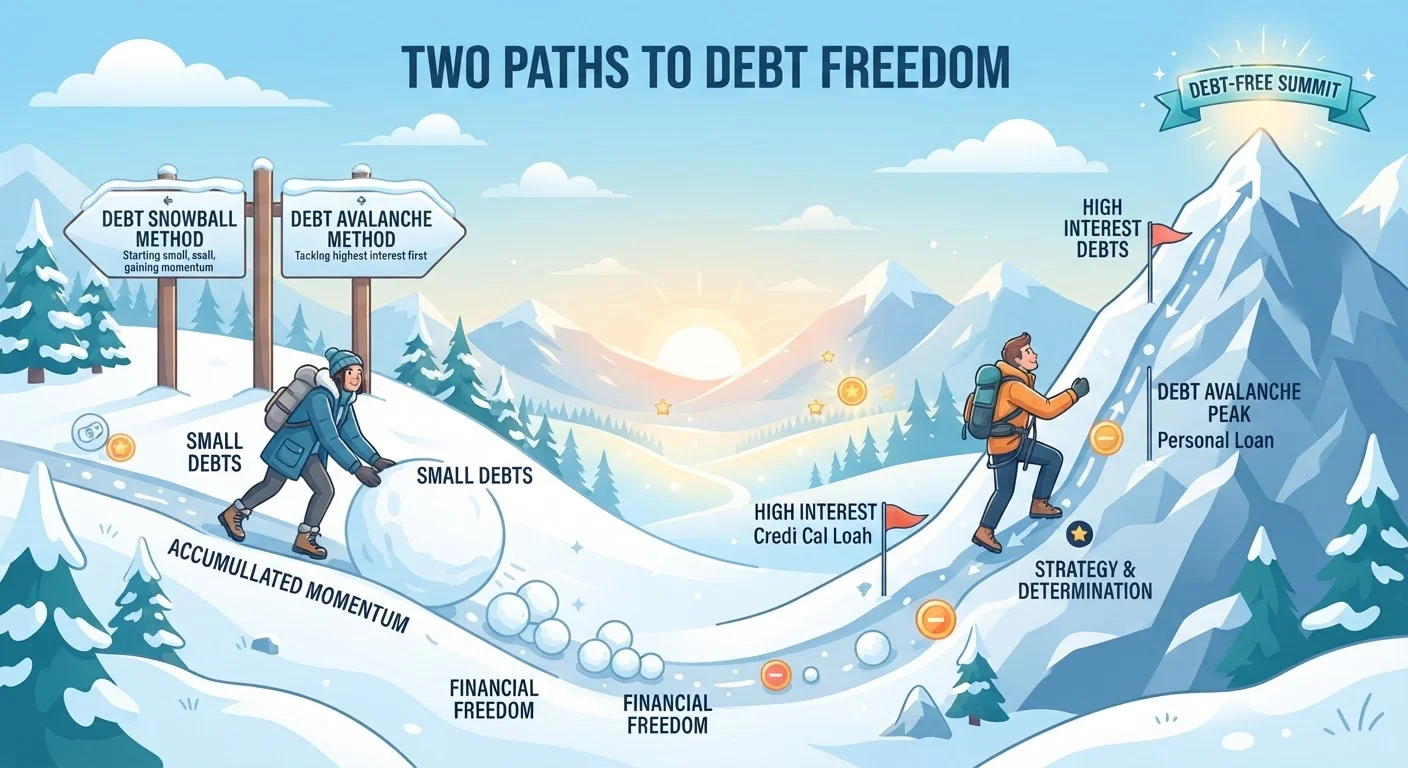
How Each Strategy Works
Both the debt snowball and the debt avalanche share the same core mechanic: you make minimum payments on all of your debts, then direct any extra money each month toward one targeted account. The two strategies differ only in how they rank which debt gets that extra payment.
Debt Snowball: List your debts from smallest balance to largest. You throw every extra dollar at the smallest balance until it's gone, then roll that freed-up payment into the next smallest. The "snowball" refers to how each paid-off account adds momentum - your available payment grows as balances disappear.
Debt Avalanche: List your debts from highest interest rate to lowest. Your extra money goes toward the highest-rate account first, regardless of its balance size. Once that debt is eliminated, you redirect those funds to the next highest rate. Interest rates - not balances - set the order.
For a fuller picture of how different debt structures work, see this guide to debt types and terms.
| Criterion | Debt Snowball | Debt Avalanche |
|---|---|---|
| Payoff order | Smallest balance first | Highest interest rate first |
| Total interest paid | Typically more | Typically less |
| Time to first payoff | Often faster | Can take longer |
| Motivational approach | Quick wins and momentum | Savings-focused, data-driven |
| Best when rates are similar | Good choice | Minimal advantage over snowball |
| Best when rates vary widely | May cost more over time | Clear mathematical advantage |
| Complexity | Simple, intuitive | Requires rate tracking |
The Real Cost Difference
The avalanche method wins on pure math. By attacking the most expensive debt first, you reduce the principal that high rates compound against - meaning every dollar of extra payment does more work. Over a multi-year repayment plan, the interest savings can be substantial, sometimes hundreds or even thousands of dollars depending on balances and rates.
The snowball method typically costs more in total interest because smaller balances don't always carry the highest rates. You may spend months clearing a low-rate account while a high-rate balance continues growing.
77%
Americans carrying some form of debt
According to Bankrate's annual financial security surveys, the vast majority of U.S. adults carry at least one form of debt.
20%+
Average credit card APR in the U.S.
The Federal Reserve has reported average credit card interest rates exceeding 20% in recent years, making high-rate debt especially costly to carry.
40%
Adults who don't pay full card balance monthly
Federal Reserve Consumer Credit data indicates a substantial share of cardholders carry revolving balances, accruing interest each month.
That said, the gap between the two methods narrows considerably when your debts carry similar interest rates, or when you have a mix of small balances that happen to be high-rate. In those cases, the two strategies may produce nearly identical outcomes - making the psychological factor the deciding variable.
It's also worth knowing that other debt tools exist. Debt consolidation can restructure multiple accounts into one, which changes how either strategy would be applied. Similarly, personal loans and balance transfer cards are tools some people use alongside a structured payoff strategy.
The Psychology of Paying Off Debt
Research in behavioral economics consistently shows that motivation and consistency matter more than optimization in personal finance. A strategy you abandon after three months - even a mathematically superior one - delivers worse outcomes than a less efficient plan you stick to for three years.
The snowball method is deliberately designed around this insight. Each paid-off balance is a concrete, measurable victory that reinforces positive behavior. For many people, seeing a debt disappear entirely from their list outweighs the abstract benefit of saving interest they can't yet see.
The avalanche method appeals to a different psychological profile: people who are energized by data, who track spreadsheets, and who find it motivating to watch their total interest cost shrink month by month. For this group, paying off a low-rate account early would feel like an inefficient use of resources.
Honest self-assessment is essential here. Consider how you've handled financial goals in the past. Have you consistently followed through, or do you tend to lose momentum without tangible progress? Your answer should influence which strategy you choose. Sound debt management principles reinforce both approaches - the strategy is the vehicle, but habits are the engine.
Choosing the Right Method for Your Situation
There is no universally correct choice between these two strategies - the right one is the one you'll sustain. A few practical considerations can help you decide:
- Look at your rate spread. If your debts vary widely in interest rate (say, an 8% auto loan versus a 24% credit card), the avalanche method produces more meaningful savings. If rates are clustered closely together, the difference in total interest paid may be small enough that psychology should drive the call.
- Count your accounts. If you have many small balances - store cards, medical bills, short-term loans - the snowball's quick wins can simplify your financial life rapidly by reducing the number of accounts you're managing.
- Assess your cash flow. Both methods require a consistent monthly surplus beyond minimums. If your budget is very tight, even a small extra payment applied strategically matters. Responsible debt management starts with knowing exactly what you can commit each month.
- Consider a hybrid. Some people start with the snowball to build momentum, then switch to avalanche logic once a few accounts are cleared and motivation is established.
If you're also weighing whether to take on new debt - for example, deciding between financing a vehicle or paying cash - see our analysis of financing versus paying cash for a car for a complementary perspective on debt trade-offs.
This article is for general informational and educational purposes only and does not constitute personalized financial or legal advice. Consult a qualified financial professional for guidance specific to your situation.