What R-Value Actually Measures
When you see an R-value on a roll of insulation, it's telling you one specific thing: how strongly that material resists the movement of heat. Heat naturally flows from warmer areas to cooler ones - from your heated living room toward your cold attic in winter, or from a hot attic into your air-conditioned rooms in summer. R-value quantifies how hard the insulation works to slow that transfer down.
Think of it like a traffic jam for heat. A material with R-13 creates a moderate slowdown; R-38 creates a much heavier one. The number itself is additive - if you install two layers that each measure R-19, the combined assembly reaches R-38. This makes it straightforward to plan how much insulation a space needs to hit a target.
It's worth noting that R-value is a laboratory measurement made under controlled conditions. Real-world performance depends on more than the number on the label - proper installation is equally important. Compressed batts, gaps around framing, or air bypasses can all significantly reduce effective thermal resistance.
Check Installation Quality, Not Just the Label
Even the highest-rated insulation underperforms when compressed, torn, or incorrectly fitted around obstructions. When installing batts, cut them to fit snugly without crushing the material - compression reduces effective R-value. If you're unsure about proper installation technique, a brief consultation with a certified energy auditor can save you from costly mistakes.
How R-Value Requirements Vary by Location
The U.S. is divided into climate zones numbered 1 through 8, ranging from the hot, humid South to the bitterly cold northern reaches. The Department of Energy publishes recommended R-values for each zone, broken down by location in the home: attic, exterior walls, floors over crawlspaces, and basement walls all have different targets.
A home in Miami (Zone 1) typically needs far less attic insulation than a home in Minneapolis (Zone 6 or 7). Installing the minimum required for Zone 1 in a Zone 6 home would leave residents with significant heat loss and high energy bills. Your local building code sets the legally required minimum, while the DOE recommendations often represent an energy-efficient target above that minimum.
R-38 to R-60
Recommended attic R-value for most U.S. climates
According to the U.S. Department of Energy's insulation recommendations, most homes benefit from attic insulation in this range depending on their climate zone.
~15%
Estimated share of home heat loss through the attic
The EPA estimates that a significant portion of a home's heating and cooling energy escapes through the attic, making it one of the highest-priority areas for insulation upgrades.
8 zones
U.S. climate zones defining insulation requirements
The DOE divides the country into eight climate zones, each with distinct recommended R-values for attics, walls, floors, and crawlspaces.
Before purchasing any insulation, check both your local building code and your climate zone requirements. Your local building or permits office can confirm what's required for new construction or permitted renovations in your area.
Common Insulation Types and Their R-Values
Different insulation materials achieve their R-values in different ways, and each has strengths depending on where it's used:
- Fiberglass batts: Among the most common types, typically rated around R-2.9 to R-3.8 per inch. Available in pre-cut widths sized to fit standard wall and floor framing.
- Mineral wool (rock wool) batts: Similar per-inch ratings to fiberglass, roughly R-3.0 to R-3.3, but tends to be denser and more resistant to moisture and fire.
- Loose-fill cellulose: Made from recycled paper treated with fire retardants, rated around R-3.2 to R-3.8 per inch. Blown into attics or enclosed cavities, it fills irregular spaces well.
- Closed-cell spray foam: Delivers a notably higher R-value per inch - approximately R-6.0 to R-7.0 - making it useful where space is limited. It also acts as an air and vapor barrier.
- Open-cell spray foam: Lower density than closed-cell, rated around R-3.5 to R-3.7 per inch. It's vapor-permeable and typically used for interior applications.
Just as understanding a product's listed specifications requires reading past the headline number, R-value comparisons between materials require looking at thickness, total installed cost, and suitability for the specific location. For a deeper look at how to interpret technical specs on any home product, see how product specifications actually work.
What R-Value Doesn't Tell You
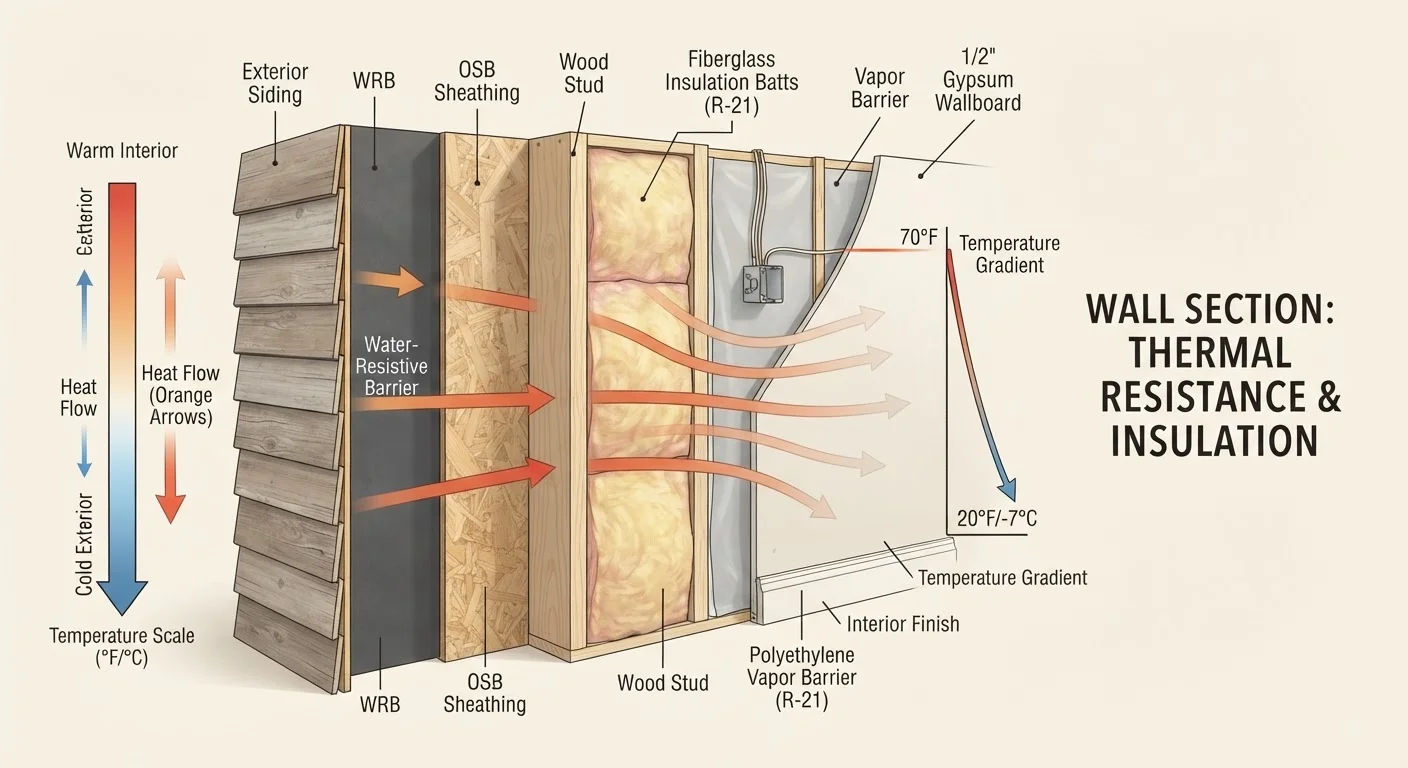
R-value is a valuable number, but it has real limits. The most significant: it says nothing about air leakage. A perfectly rated batt installed in a wall full of gaps around electrical outlets, plumbing penetrations, or poorly sealed framing joints can allow warm or cold air to move through those gaps freely - bypassing the insulation entirely. This is why building professionals emphasize air sealing as a companion step to any insulation upgrade.
R-value also doesn't account for moisture. Wet insulation - particularly fiberglass - loses much of its thermal resistance. Identifying and addressing sources of moisture before insulating is essential, especially in basements and crawlspaces.
Finally, thermal bridging is a factor R-value doesn't capture. Wood framing studs, metal connectors, and other structural elements conduct heat more readily than the insulation between them. An entire wall assembly - framing and insulation together - performs at a lower effective thermal resistance than the insulation's label suggests on its own.
This article is for general informational purposes only. Always verify local building codes and permit requirements before beginning any insulation project. For work involving structural, electrical, or major HVAC components, consult a licensed professional.