How Dollar-Cost Averaging Actually Works
Imagine you commit to investing $200 every month into a broad market index fund. Some months, the fund's share price is $40 - so your $200 buys 5 shares. Other months, the price drops to $25 - and that same $200 buys 8 shares. When prices rebound to $50, you're only getting 4 shares. Because you're spending the same dollar amount each time, your share count naturally fluctuates with the market.
The result: over many months and years, you accumulate shares at a blended average cost that reflects both the highs and the lows - not just the unfortunate moment you happened to invest. This smoothing effect is the core mechanical benefit of DCA.
If you're new to investing concepts like shares, funds, and accounts, the Investing Your Money guide for beginners provides a solid foundation before applying this strategy.
~55%
U.S. adults who own stock
According to Gallup's annual Economy and Personal Finance survey, roughly 55-61% of American adults report owning stock, including through retirement accounts.
20+ years
Average holding period linked to better outcomes
Research on long-term investing broadly shows that longer holding periods have historically reduced the likelihood of negative returns in diversified equity portfolios, though no outcome is guaranteed.
~$7,000
2024 IRA annual contribution limit
The IRS set the annual IRA contribution limit at $7,000 for 2024 ($8,000 if age 50 or older), making DCA a natural fit for spreading contributions throughout the year.
Why Timing the Market Is So Difficult
One of the oldest pieces of financial wisdom is that "time in the market beats timing the market." The reason: markets move unpredictably in the short term. Even professional fund managers with extensive research teams and sophisticated tools struggle to consistently buy at lows and sell at highs.
For everyday investors, the attempt to time the market often leads to a counterproductive pattern: hesitating to invest when markets feel uncertain (missing gains) and rushing in after a rally (buying at higher prices). Fear and optimism tend to drive poor decisions when a fixed investment schedule does not.
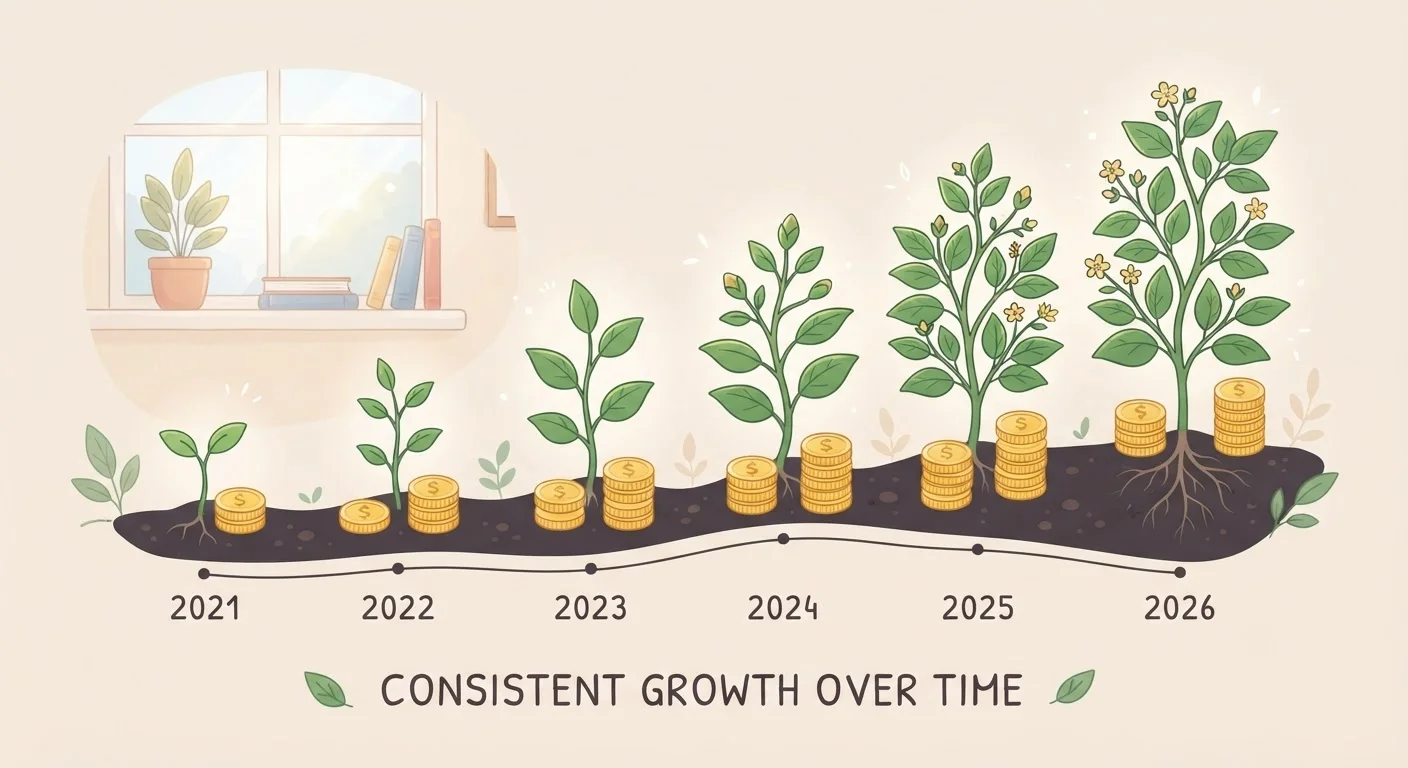
Dollar-cost averaging sidesteps this entirely. Because your contributions happen on a schedule - not based on how the market feels that week - you remain invested through volatility without needing to predict what comes next. Consistency becomes your strategy.
Putting DCA Into Practice
The most practical way to apply DCA is through automation. When contributions happen automatically, you remove the temptation to pause or second-guess during turbulent periods. Many workplace retirement plans do this by design - each paycheck, a portion flows into your 401(k) without you lifting a finger. Individual retirement accounts (IRAs) and standard brokerage accounts can be set up similarly with recurring transfers.
When choosing your contribution amount, prioritize what you can sustain consistently over what sounds most ambitious today. A smaller, reliable contribution tends to outperform a larger one that gets paused whenever life gets expensive. The case for automatic contributions explores how automation supports long-term investing discipline in more detail.
Building broader financial habits around consistent saving also matters. The financial habits that support long-term saving goals offers practical guidance on creating a sustainable savings routine alongside your investment contributions.
Start With What You Can Sustain
When setting your DCA contribution amount, choose a figure that fits comfortably within your current budget - not your ideal future budget. Contributions you pause or stop during tight months undercut the consistency that makes the strategy work. A small, uninterrupted investment schedule generally serves long-term goals better than a large one that gets interrupted.
This article is for general informational and educational purposes only and does not constitute personalized financial or investment advice. Investing involves risk, including possible loss of principal. Past performance does not guarantee future results. Consult a qualified financial professional before making investment decisions based on your individual circumstances.
What DCA Doesn't Do
It's important to be clear about the limits of this approach. Dollar-cost averaging does not protect you from investment loss. If an asset steadily declines in value over years, buying it consistently on a schedule will accumulate losses just as steadily. DCA is most effective when applied to diversified, long-term holdings - not to speculative or single-company bets.
DCA also doesn't automatically mean you're in the right investment. The strategy is a delivery mechanism for getting money into markets consistently - what you invest in still matters. Diversified index funds are commonly discussed in this context because they spread risk across many companies rather than concentrating it, but any investment involves risk.
Finally, note that frequent small purchases can occasionally mean higher transaction costs, though many modern platforms have eliminated per-trade fees. Confirming that your platform supports cost-effective recurring contributions is a sensible step before setting up your schedule.
A nurse contributes $150 from each biweekly paycheck into her employer's 401(k) plan, invested in a target-date fund.
A recent college graduate sets up a $75 monthly automatic transfer from his bank account into a brokerage account invested in a broad index fund.
During a market downturn, a teacher's fixed monthly $200 contribution purchases significantly more shares than it did the previous quarter.